





QR Code

Products
Contact Us


Fax
+86-579-87223657

Email

Address
Wangda Road, Ziyang Street, Wuyi County, Jinhua City, Zhejiang Province, China



Silicon carbide (SiC) ceramics wafer boats have emerged as indispensable tools in modern semiconductor and photovoltaic fabrication environments. These advanced components play a pivotal role in wafer processing steps such as oxidation, diffusion, epitaxial growth, and chemical vapor deposition. With unmatched thermal stability, corrosion resistance, and mechanical strength, SiC wafer boats ensure processing precision and yield optimization, especially in high-temperature applications. This comprehensive guide explores the key functions, materials science foundations, applications, and advantages of SiC ceramics wafer boats, backed by industry examples and technical comparisons.
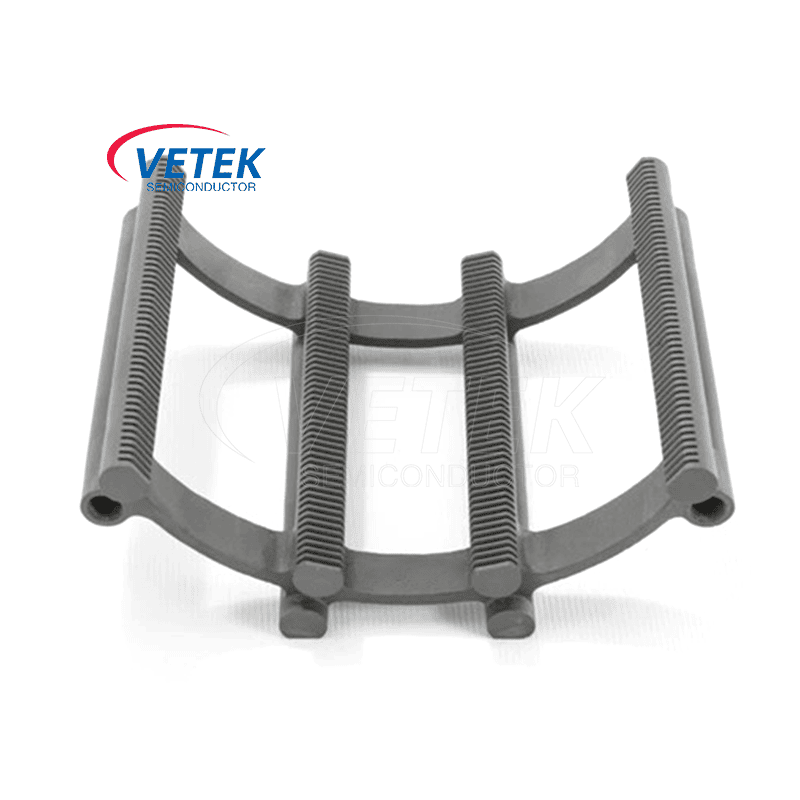
A SiC ceramics wafer boat is a high-performance carrier used in high-temperature semiconductor and PV furnace processes to hold and transport wafers during critical fabrication stages such as oxidation, diffusion, annealing, and epitaxial growth. Its core purpose is to ensure uniform temperature distribution and mechanical support without introducing contaminants.
Companies like VeTek provide advanced silicon carbide wafer boats engineered for reliability and longevity, making them suitable for modern manufacturing demands.
The excellent performance of SiC wafer boats stems from fundamental material properties of silicon carbide, including high purity, low porosity, and high thermal conductivity. The following table summarizes typical key technical parameters of recrystallized SiC used in wafer boats:
| Property | Typical Value |
|---|---|
| Working Temperature (°C) | 1600 (oxidizing), 1700 (reducing) |
| SiC Content | > 99.96% |
| Free Silicon | < 0.1% |
| Bulk Density (g/cm³) | 2.60–2.70 |
| Thermal Conductivity @ 1200°C | 23 W/m·K |
| Elastic Modulus | 240 GPa |
| Thermal Expansion @ 1500°C | 4.7×10⁻⁶/°C |
Silicon carbide ceramics exhibit a set of exceptional physical properties that make them ideal for harsh semiconductor processing environments:
SiC wafer boats are central to multiple advanced fabrication processes, including:
Compared with traditional wafer carriers made from quartz or graphite, SiC ceramics wafer boats offer superior performance:
| Feature | SiC Wafer Boat | Traditional Quartz/Graphite |
|---|---|---|
| Max Temperature | ~1700°C+ | ~1200°C |
| Chemical Resistance | Excellent | Moderate |
| Thermal Expansion | Low | Medium-High |
| Contamination Risk | Very Low | Moderate |
| Lifespan | Long | Short |
The enhanced performance directly translates into improved wafer yields, lower replacement costs, and more stable process control.
SiC wafer boats provide several strategic advantages to modern fabs, including:
High-purity silicon carbide wafer boats typically withstand continuous operating temperatures around 1600 °C and short peak temperatures up to ~1700 °C in certain atmospheres.
Their low contamination characteristics, thermal stability, and mechanical strength reduce defects and warpage, ultimately improving overall yield and process stability.
Yes. Leading suppliers like VeTek offer customization for slots, size, and structural design to fit various furnace and reactor configurations.
While predominantly used in semiconductor fabs, they also serve in photovoltaics, LED manufacturing, and other high-temperature materials processing contexts.
Silicon carbide ceramics wafer boats represent a technologically advanced, reliable solution for high-temperature wafer processing. Their material excellence, contamination resistance, thermal stability, and adaptability make them a strategic asset for semiconductor and PV manufacturers looking to enhance efficiency and product quality. If you’re ready to explore high-performance SiC wafer boats tailored to your process needs, reach out to VeTek and contact us to discuss customization, pricing, and sample testing options.
+86-579-87223657
Wangda Road, Ziyang Street, Wuyi County, Jinhua City, Zhejiang Province, China