




QR Code

Products
Contact Us


Fax
+86-579-87223657

Email

Address
Wangda Road, Ziyang Street, Wuyi County, Jinhua City, Zhejiang Province, China



Article Summary: As semiconductor manufacturing advances toward higher precision, higher temperatures, and more aggressive plasma environments, material selection for critical components becomes increasingly important. The Tantalum Carbide Coating Ring has emerged as a key solution for plasma-facing and high-temperature applications due to its exceptional hardness, thermal stability, and chemical resistance. This article provides a comprehensive, in-depth exploration of what a tantalum carbide coating ring is, how it works, why it outperforms traditional materials, and why leading manufacturers trust solutions from VeTek semiconductor.
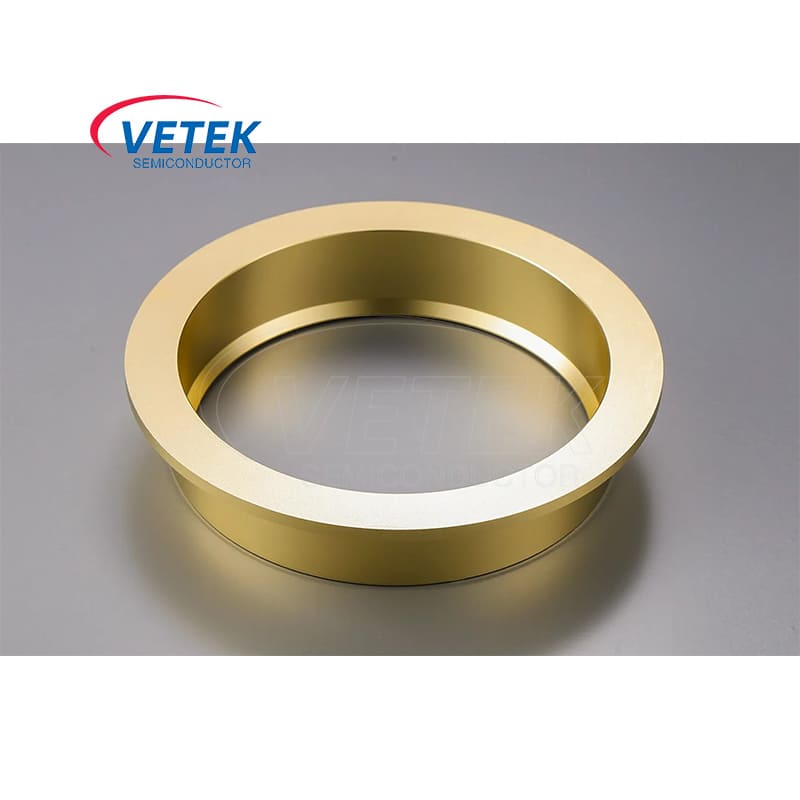
A Tantalum Carbide Coating Ring is a precision-engineered ring component used primarily in semiconductor equipment, where it serves as a protective and functional interface between plasma, high-temperature processes, and underlying structural materials.
The ring typically consists of a substrate (often graphite or carbon-based material) that is coated with a dense, uniform layer of tantalum carbide (TaC). This coating dramatically enhances the component’s resistance to:
Because tantalum carbide has one of the highest melting points among known compounds, it is especially suitable for harsh semiconductor manufacturing environments such as etching, CVD, and epitaxial growth.
Tantalum carbide is a refractory ceramic material renowned for its outstanding physical and chemical properties. These properties are what make tantalum carbide coating rings so valuable in advanced semiconductor processing.
| Property | Tantalum Carbide (TaC) |
|---|---|
| Melting Point | ~3880°C |
| Hardness | Extremely high (Mohs ~9–10) |
| Thermal Stability | Excellent at ultra-high temperatures |
| Chemical Resistance | Highly resistant to acids and plasma |
| Thermal Conductivity | High |
These properties enable tantalum carbide coating rings to maintain structural integrity and surface stability even after prolonged exposure to aggressive processing conditions.
In modern semiconductor fabrication, even microscopic contamination or material degradation can lead to yield loss. Tantalum carbide coating rings play a critical role in maintaining process stability and product quality.
Key reasons why these rings are essential include:
This makes tantalum carbide coating rings an indispensable component in next-generation semiconductor tools.
Tantalum carbide coating rings are widely used in processes that demand both thermal endurance and plasma resistance.
In these environments, traditional materials may crack, erode, or generate particles. Tantalum carbide coatings provide a robust barrier that protects both the component and the process.
Choosing the right coating material is a critical decision in semiconductor equipment design. Below is a comparison between tantalum carbide and commonly used alternatives.
| Material | Temperature Resistance | Plasma Resistance | Service Life |
|---|---|---|---|
| Tantalum Carbide | Excellent | Excellent | Very Long |
| Silicon Carbide (SiC) | Good | Good | Moderate |
| Aluminum Oxide | Moderate | Fair | Short |
This comparison clearly shows why tantalum carbide coating rings are increasingly favored in advanced semiconductor manufacturing.
The performance of a tantalum carbide coating ring depends heavily on coating uniformity, adhesion, and purity.
At VeTek semiconductor, advanced coating technologies are used to ensure:
Each tantalum carbide coating ring undergoes rigorous inspection to meet semiconductor-grade standards.
Particle contamination is one of the most critical challenges in semiconductor fabrication. Tantalum carbide coating rings help mitigate this risk in several ways:
By maintaining a stable and durable surface, tantalum carbide coatings contribute directly to higher yields and more reliable processes.
VeTek semiconductor is a trusted supplier of advanced coating solutions for the semiconductor industry. With deep expertise in tantalum carbide coating technology, VeTek delivers:
By partnering with VeTek semiconductor, manufacturers gain access to materials engineered for the most demanding semiconductor applications.
The primary advantage is its exceptional resistance to high temperatures, plasma erosion, and chemical attack, which significantly extends component life.
They are especially suitable for plasma-facing and high-temperature tools, such as etching and CVD systems.
Tantalum carbide generally offers superior plasma resistance and thermal stability, making it ideal for more demanding applications.
Yes. Their durability reduces wear-related failures, extending maintenance intervals.
High-quality solutions are available from specialized suppliers such as VeTek semiconductor, which focuses on semiconductor-grade coating technologies.
Conclusion:
As semiconductor processes continue to evolve, the demand for materials that can withstand extreme environments will only increase. The Tantalum Carbide Coating Ring stands out as a critical component that enhances performance, reliability, and yield. If you are seeking advanced coating solutions tailored for next-generation semiconductor equipment, contact us at VeTek semiconductor to explore how tantalum carbide coating rings can elevate your manufacturing processes.
+86-579-87223657
Wangda Road, Ziyang Street, Wuyi County, Jinhua City, Zhejiang Province, China