


QR Code

Products
Contact Us


Fax
+86-579-87223657

Email

Address
Wangda Road, Ziyang Street, Wuyi County, Jinhua City, Zhejiang Province, China


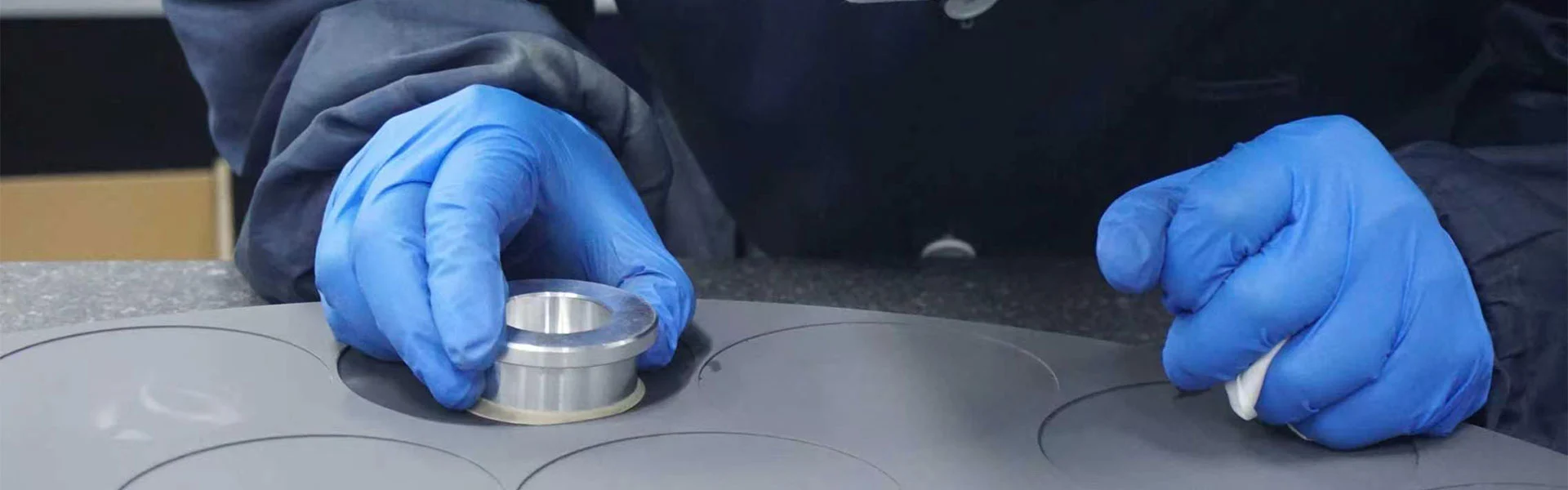
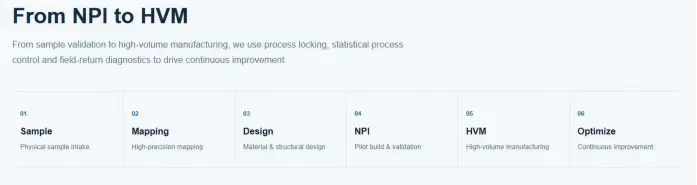
The greatest challenge in smoothly transitioning from New Product Introduction (NPI) to High-Volume Manufacturing (HVM) is consistency. Through process locking, SPC statistical process control, and in-depth diagnosis of field-returned parts, we ensure that the 1,000th product is indistinguishable in quality from the first sample.
A leading TOPCon photovoltaic cell manufacturer: During initial introduction, graphite boat accessories exhibited film-thickness variation (±15%) between batches, affecting coating uniformity. We initiated full-process SPC monitoring and locked three critical process parameters (deposition temperature, gas flow rate, chamber pressure). Within 3 weeks, film-thickness uniformity variation was narrowed from ±15% to within ±3%. The line has now been stably supplied for more than 200 batches, with batch pass rate consistently above 99.2%, helping the customer reduce wafer breakage rate by 1.5%.
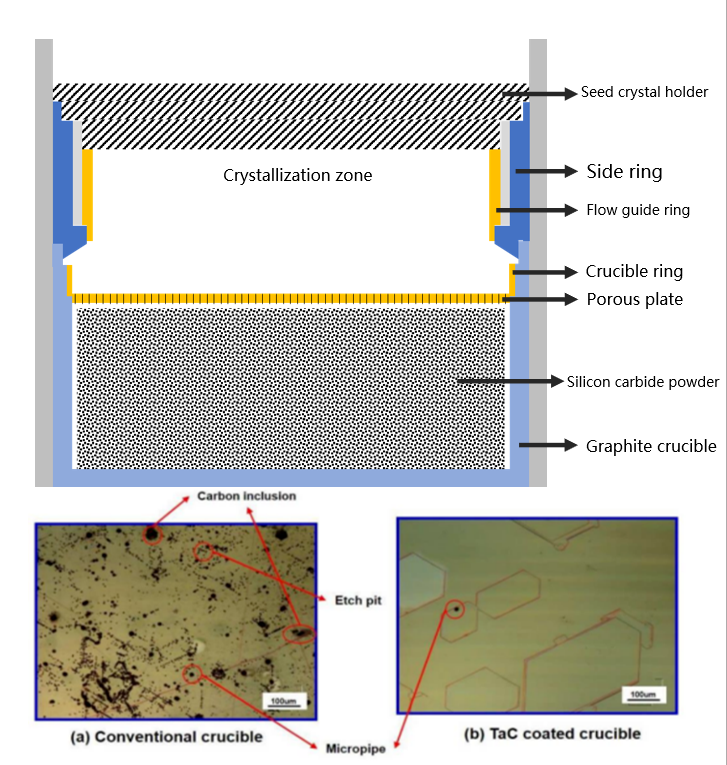
A: Look at your process temperature and gas-phase corrosion intensity. If the process temperature is below 1000 °C and mainly involves Cl₂/F₂-based etching or conventional epitaxy, choose CVD SiC for the best cost-performance; if the process temperature exceeds 1200 °C and involves strongly corrosive atmospheres (e.g., SiC PVT single-crystal growth), we recommend CVD TaC , which offers superior temperature and corrosion resistance. We can provide a free selection recommendation report based on your specific process parameters.
A: Yes! For reverse-engineering prototypes, MOQ is 1 piece . For conventional simple parts, from receipt of sample to delivery of the mapped part, the fastest lead time is approximately 10–15 working days ; for parts involving complex coating processes it is approximately 20–25 working days . Contact our engineers for expedited evaluation.
A: 90% of delamination cases are caused by mismatch between the coefficient of thermal expansion (CTE) of the graphite substrate and the coating, leading to fatigue peeling under rapid heating/cooling. Our solution: first precisely measure the CTE curve of your original part, then specially adjust substrate density and deposition temperature gradient so that the two CTEs are highly matched. Bond strength can be improved to more than 1.5 times the industry conventional level.
A: Every shipped product comes standard with a unique serial number + full CoA report . The report includes: critical dimension CMM inspection data, multi-point coating thickness distribution map, surface roughness (Ra) values, and material purity (GDMS) analysis conclusions.
Phone: +86-18069220752 (Tina); +86-15988690905 (Sera)
Email: anny@veteksemi.com
+86-579-87223657
Wangda Road, Ziyang Street, Wuyi County, Jinhua City, Zhejiang Province, China