
QR Code
Products
Contact Us


Fax
+86-579-87223657

E-mail

Address
Wangda Road, Ziyang Street, Wuyi County, Jinhua City, Zhejiang Province, China
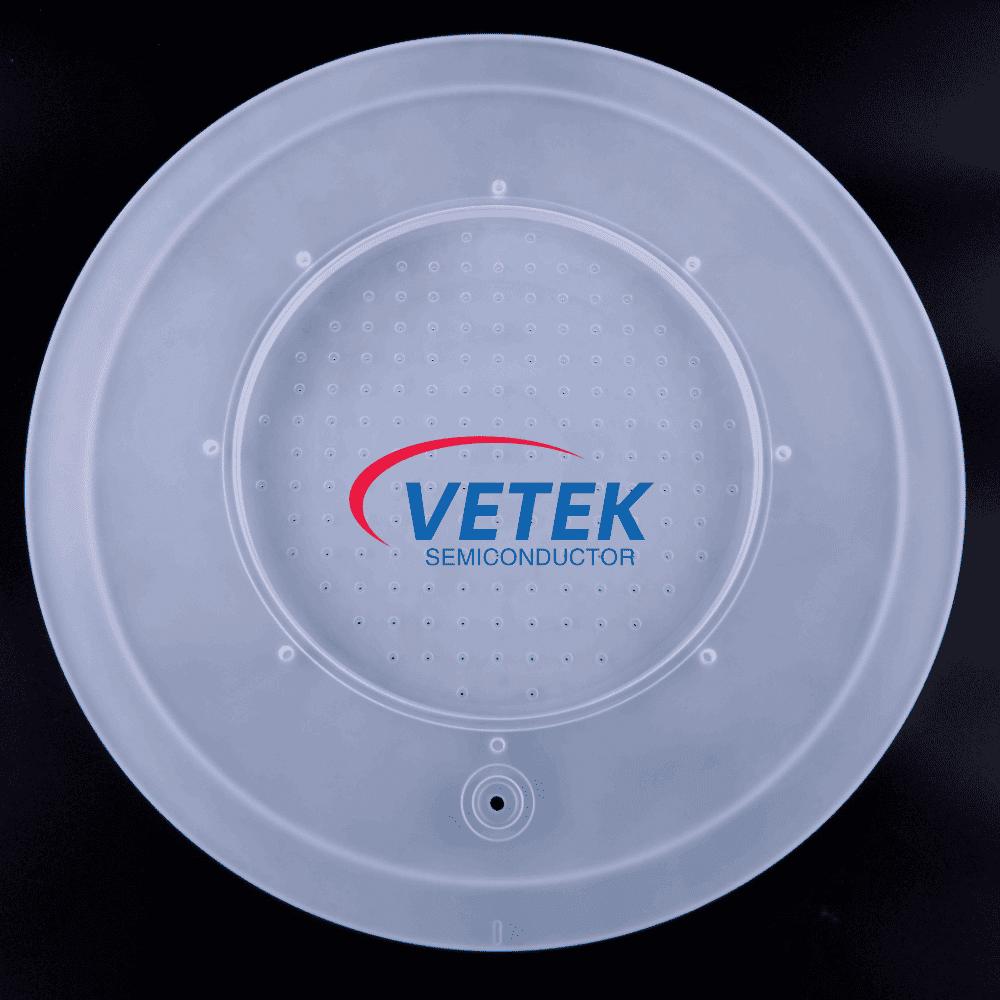
A SiC-coated graphite susceptor is not simply a wafer holder. In semiconductor epitaxy, it is a thermal-field component, a mechanical interface and a process-facing surface at the same time. Its graphite body provides machinability and thermal functionality, while the CVD SiC coating provides a chemically stable surface close to the wafer. Because wafer temperature is coupled to susceptor geometry, flatness, pocket design and surface condition, susceptor quality can influence epitaxial uniformity and run-to-run stability.
During silicon or SiC epitaxy, the wafer must be positioned inside a tightly controlled thermal and chemical environment. The susceptor supports the wafer, couples or absorbs energy from the reactor, transfers heat toward the wafer and defines the physical boundary immediately below it. For this reason, the component cannot be judged only by graphite grade or coating thickness.
SGL Carbon states that the properties and quality of graphite susceptors have a crucial effect on epitaxial-layer quality and emphasizes high-purity isostatic graphite, homogeneous SiC coating and close dimensional tolerances. Its ASM susceptor program also highlights pocket profile, flatness, surface finish and purity as process-relevant specifications.
The engineering relationship can therefore be expressed as:
Susceptor Material + Geometry + Flatness + Coating Condition → Wafer Thermal Boundary → Wafer Temperature Distribution → Epitaxial Growth
The susceptor does not act alone. Gas flow, reactor design, wafer rotation, pressure, precursor chemistry and temperature-control strategy remain essential. However, the susceptor is one of the primary hardware interfaces through which these conditions are delivered to the wafer.
For an epitaxy susceptor, dimensional accuracy is also a thermal parameter.
A wafer pocket that is too deep, too shallow or locally distorted changes the spacing between the wafer and susceptor surface. Flatness error can alter local thermal contact, radiative exchange and the effective thermal boundary underneath the wafer. On a multi-pocket carrier, small differences between pockets may therefore produce different local temperature histories even when the nominal reactor set point remains unchanged.
Pocket diameter, pocket depth, edge profile, wall thickness, concentricity and overall flatness should consequently be treated as a connected design system rather than as isolated dimensions.
Commercial susceptor specifications reflect this relationship. SGL Carbon identifies pocket profile, flatness and dimensional compliance as important characteristics of silicon epitaxy susceptors, while Mersen emphasizes precision machining and thermal uniformity in coated graphite equipment for epitaxy.
The more useful engineering question is therefore not simply:
> Is the part within drawing tolerance?
It is:
> Are the critical dimensions controlled tightly enough to preserve the intended thermal boundary at every wafer position?
This distinction becomes especially important for replacement susceptors. A component may appear geometrically similar to an existing part yet behave differently if its pocket profile, flatness, graphite grade, surface finish or coating architecture differs from the qualified design.
The CVD SiC coating is often described as a protective layer, but that definition is incomplete.
Its first function is chemical. A dense SiC surface reduces direct exposure of the graphite substrate to high-temperature process gases and cleaning chemistry. Its second function is contamination control because the coating becomes the process-facing surface closest to the wafer. Its third function is surface stability: the susceptor must maintain a consistent condition through repeated deposition, cleaning, heating and cooling cycles.
SGL Carbon describes its SiC coatings as dense CVD layers with high chemical and thermal resistance and notes that the thermal-expansion behavior of the graphite substrate should be adapted to the coating to minimize thermal stress. Mersen likewise identifies graphite/SiC CTE compatibility as important for long-term coating integrity.
For epitaxy, coating quality should therefore be evaluated using more than nominal thickness. Thickness uniformity, surface roughness, pinhole resistance, interface stability and coating integrity matter because cracking, peeling or progressive surface roughening changes the boundary presented to the wafer.
The finished susceptor is better understood as a coupled material system:
Graphite Substrate + Precision Geometry + CVD SiC Surface + Interface Integrity
A change in any one of these elements can alter the behavior of the complete component.
This is also why “thicker coating” should not automatically be interpreted as “better coating.” A coating must provide adequate protection while remaining compatible with the substrate, component tolerances and repeated thermal cycling.
Epitaxial growth is highly sensitive to temperature. Local wafer temperature therefore contributes to growth rate, layer thickness, composition and electrical-property uniformity.
If susceptor flatness changes, a wafer pocket wears, deposits accumulate unevenly, or the SiC coating locally degrades, the thermal and chemical boundary around the wafer may also change. The result is not automatically a defective wafer, but the risk of pocket-to-pocket, wafer-to-wafer or run-to-run variation can increase.
The mechanism can be simplified as:
Geometry or Surface Change → Local Thermal Boundary Change → Wafer Temperature Change → Growth-Kinetics Change
A similar principle applies to rotating MOCVD wafer carriers. SGL Carbon links high-purity graphite, homogeneous SiC coating, thermal conductivity and tight dimensional tolerances with wafer-carrier performance in LED production.
It is therefore too simplistic to claim that a “better SiC coating increases yield.” A more technically defensible conclusion is that a stable, dimensionally controlled SiC-coated graphite susceptor helps maintain the thermal and surface conditions required for repeatable epitaxy.
This also changes the way non-uniformity should be investigated.
When an epitaxy reactor begins to show unexplained drift, process engineers naturally examine temperature settings, gas flow, pressure and precursor delivery. Susceptor condition should be included in the same investigation. Flatness, pocket wear, deposit history, coating integrity and dimensional conformity of replacement parts can all become relevant variables.
In this sense, the susceptor is not merely a consumable component. It is part of the process-control hardware.
Susceptor degradation is often gradual rather than catastrophic. A part may remain mechanically intact while its process behavior has already begun to change.
Coating cracking or delamination can expose graphite and increase particle risk. Edge peeling may indicate local stress concentration. Surface roughening changes the process-facing condition and may influence subsequent deposit behavior. Pocket wear can alter wafer positioning, while loss of flatness changes the thermal relationship between the wafer and susceptor. Non-uniform coating degradation can also create different surface conditions across the same component.
These changes may result from thermal cycling, graphite/SiC CTE mismatch, process chemistry, aggressive cleaning, mechanical handling, coating defects or accumulated service time.
The relevant engineering question is therefore not only:
> Has the susceptor failed?
but rather:
> Has the susceptor changed enough to alter the process boundary experienced by the wafer?
Visual inspection alone may not be sufficient to answer this question. Depending on the process, meaningful qualification can include dimensional measurement, flatness verification, pocket-profile inspection, surface-condition assessment and coating-integrity evaluation.
This is why there is no universal number of process cycles after which every SiC-coated graphite susceptor should be replaced. Cleaning, recoating or replacement should be based on component condition and process evidence.
A technically useful RFQ should begin with the reactor and process rather than with a generic request for “SiC-coated graphite.”
The supplier should first understand the reactor manufacturer and model, whether the component is used for silicon epitaxy or SiC epitaxy, wafer size, pocket configuration, heating method, operating temperature range, process gases and cleaning chemistry.
The component definition should then establish the dimensions that influence process behavior, particularly flatness, pocket depth, pocket diameter, edge geometry and other critical tolerances. Graphite grade, purity, CVD SiC coating requirements, surface finish and inspection criteria should be defined around these requirements.
A practical selection sequence is:
Reactor → Process → Geometry → Graphite → SiC Coating → Inspection
For replacement components, an existing drawing is extremely valuable, but the drawing alone may not contain every process-critical requirement. Qualified material grade, coating specification, historical inspection data and actual operating conditions can be equally important.
The objective is not simply to maximize coating life. It is to preserve a repeatable relationship between the susceptor and the wafer throughout the component's service period.
That means maintaining the combination of:
Dimensional Stability + Thermal Consistency + Surface Integrity + Low Contamination + Low Particle Risk
required by the epitaxy process.
1. What does a SiC-coated graphite susceptor do in epitaxy?
It supports the wafer while acting as part of the reactor thermal field and as the process-facing surface below the wafer. Its geometry and surface condition help define the wafer's local thermal environment.
2. Why are graphite susceptors coated with SiC?
Graphite provides machinability and useful thermal behavior, while CVD SiC provides a more chemically stable and contamination-resistant process-facing surface.
3. How does susceptor flatness affect epitaxial uniformity?
Flatness changes the geometric and thermal relationship between the wafer and susceptor. Excessive deviation can alter local heat transfer and contribute to wafer-temperature non-uniformity.
4. Can SiC coating damage affect wafer quality?
Coating damage can affect process stability by exposing graphite, generating particles or changing the local surface condition. The practical impact depends on the location and severity of the damage and the reactor process.
5. What information is needed for a custom or replacement susceptor RFQ?
Provide the reactor model, process type, wafer size, drawing or STEP file, pocket geometry, flatness and critical tolerances, graphite requirement, SiC coating specification, surface finish, inspection requirements and quantity.
1. SGL Carbon — Graphite Susceptors and Components for Silicon and SiC Epitaxy. Technical information on high-purity isostatic graphite, homogeneous SiC coatings, dimensional tolerances and epitaxy applications.
2. SGL Carbon — Susceptors for ASM Epsilon Reactors. Technical information on pocket profile, flatness, surface finish, purity, coating and dimensional control for silicon epitaxy susceptors.
3. Mersen — Semiconductor Process Equipment. Technical information on ultra-pure SiC-coated graphite, CTE compatibility, precision machining and epitaxy/MOCVD applications.
+86-579-87223657
Wangda Road, Ziyang Street, Wuyi County, Jinhua City, Zhejiang Province, China
Copyright © 2024 WuYi TianYao New Material Tech.Co.,Ltd. All Rights Reserved.
Links | Sitemap | RSS | XML | Privacy Policy |