





QR Code

Products
Contact Us


Fax
+86-579-87223657

E-mail

Address
Wangda Road, Ziyang Street, Wuyi County, Jinhua City, Zhejiang Province, China



In semiconductor epitaxy, graphite is rarely selected simply because it can withstand high temperature. Its real value lies in the combination of machinability, thermal response, electrical behavior and the ability to form complex reactor components such as barrel susceptors, pancake susceptors, single-wafer holders and MOCVD carriers. Yet the same graphite surface that provides these advantages is not always suitable for direct and repeated exposure to the epitaxy environment. This is why many critical graphite components are protected with a dense chemical vapor deposited silicon carbide coating, creating what is commonly described as SiC-coated graphite.
The engineering concept is simple but important: the graphite body provides the structural and thermal platform, while the CVD SiC layer becomes the process-facing surface. The resulting component must therefore be considered as one integrated material system rather than as graphite with an optional protective layer.
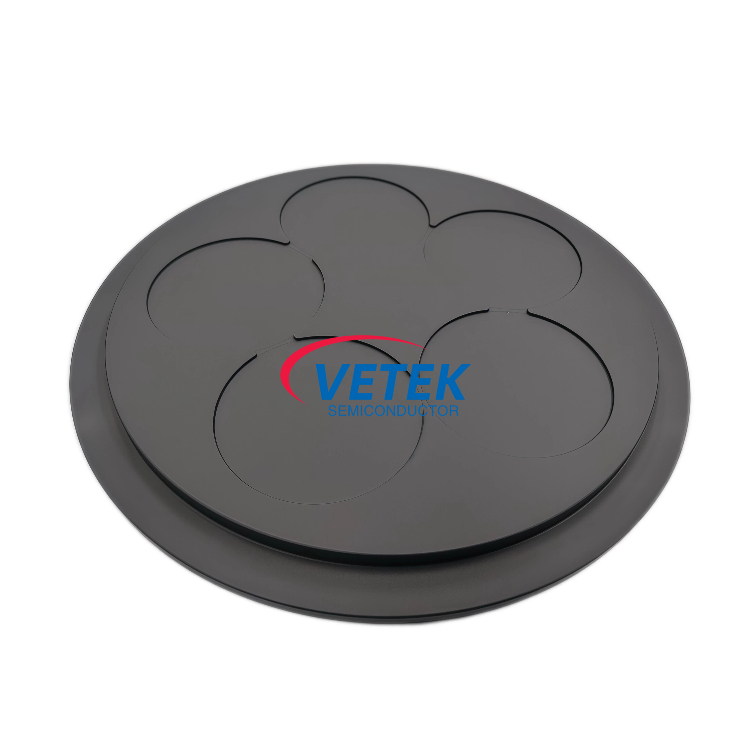
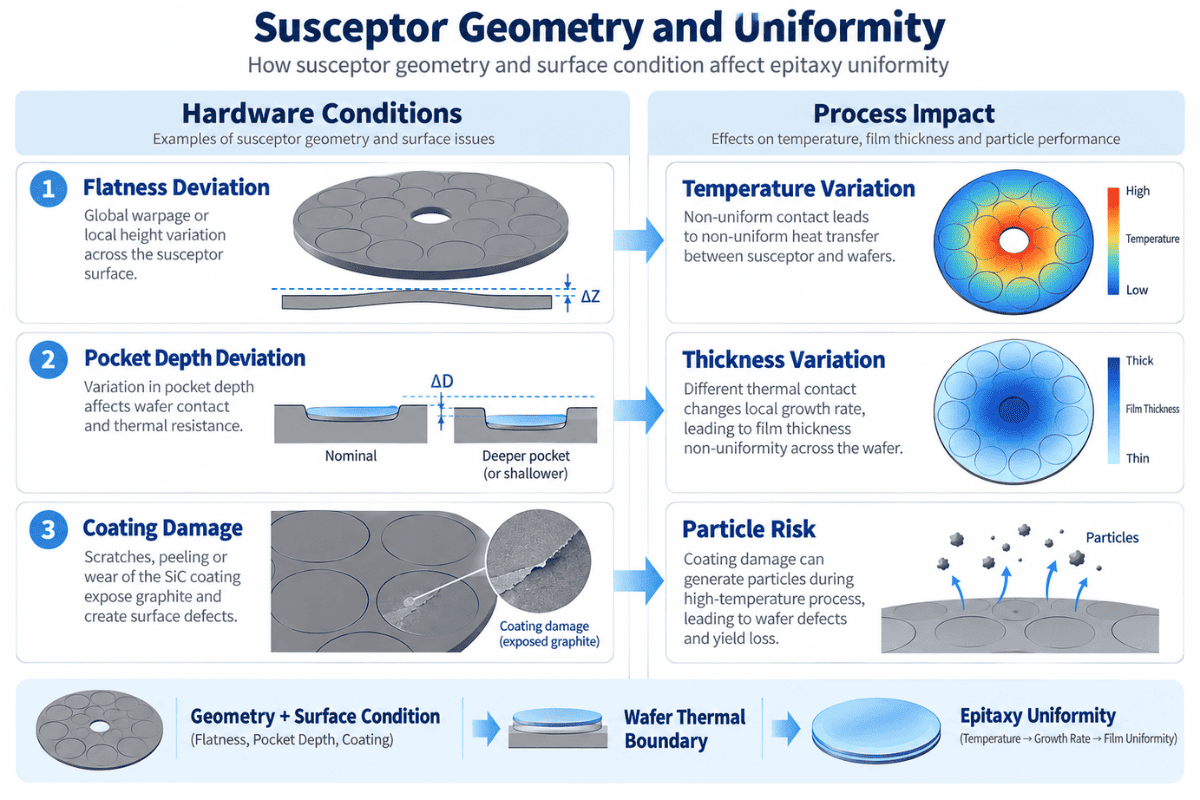
An epitaxy susceptor performs considerably more work than simply holding a wafer. It establishes the mechanical position of the wafer, participates in heat transfer and, depending on reactor design, interacts with rotation, induction heating and gas flow. Small changes in pocket depth, flatness, surface profile or thermal behavior can change the local wafer environment and ultimately influence epitaxial uniformity.
This requirement explains the continued use of fine-grain and isostatic graphite. Graphite can be precision-machined into geometries that would be considerably more difficult or expensive to manufacture from many dense ceramic materials. It also provides thermal and electrical characteristics compatible with several hot-wall and induction-heated reactor concepts.
For commercial silicon and SiC epitaxy, SGL Carbon identifies high-strength isostatic graphite as the base material for coated susceptors and notes that susceptor material quality has a direct influence on the quality of the epitaxial layer. Tight dimensional tolerances, homogeneous coating and purity are therefore treated as connected requirements rather than independent specifications.
The difficulty is that a material suitable for building the thermal body is not necessarily the optimum surface for contact with the process atmosphere. This distinction is the fundamental reason for applying silicon carbide.
A bare graphite component operates in an environment containing high temperatures, reactive precursor gases and repeated heating and cooling. Under these conditions, the surface can gradually become part of the reactor chemistry.
In silicon carbide epitaxy this issue is particularly clear. Published work on chloride-based SiC CVD describes graphite susceptors coated with SiC specifically to prevent impurities and additional hydrocarbons from being released from hot graphite during growth. The same work reports that degradation of the SiC coating at hot spots can affect run-to-run reproducibility, illustrating that the condition of the susceptor surface can become part of the process itself.
The risk is therefore broader than simple oxidation. Direct exposure may lead to chemical attack, progressive surface roughening, liberation of particles, exposure of trace impurities or unwanted reactions between the graphite and the process gas. Cleaning cycles can introduce another stress mechanism because the same component must repeatedly survive both deposition chemistry and chamber-cleaning chemistry.
For semiconductor production, this creates an undesirable feedback loop. Surface degradation changes the condition of the susceptor; a changing susceptor can modify the local chemical and thermal boundary around the wafer; and a changing boundary can reduce process repeatability.
The purpose of coating graphite is therefore not merely to make the part “more corrosion resistant.” It is to keep the process-facing boundary more stable over time.
A CVD SiC coating creates a dense silicon carbide surface over the machined graphite body. Commercial SiC coatings are commonly deposited by chemical vapor deposition at temperatures above approximately 1,200°C. SGL Carbon reports typical deposition temperatures of 1,200–1,300°C and specifically emphasizes that the thermal-expansion behavior of the graphite substrate should be matched to the coating to minimize thermal stress.
Once deposited, the SiC layer acts as a functional interface between the graphite and the reactor atmosphere. Its chemical resistance reduces direct attack on the underlying carbon. Its density limits direct exposure of the graphite to the process environment. Its high purity provides a more controlled surface close to the wafer, and its mechanical integrity helps reduce erosion-related particle generation.
These advantages depend on the coating remaining intact. A coating with poor thickness uniformity, local pinholes, residual stress or weak adhesion may eventually crack or delaminate. When that happens, the graphite is exposed again and the protective function is locally lost.
For this reason, coating thickness alone is not a meaningful quality metric. The more useful engineering parameters are the combination of purity, density, surface roughness, thickness uniformity, microstructure, substrate compatibility and interface integrity.
Mersen follows the same material-system approach in its semiconductor equipment guidance. It describes ultra-pure graphite coated with SiC for epitaxy and MOCVD and specifically highlights CTE compatibility between graphite and silicon carbide as a condition for long-term coating integrity.
In practical terms, the ideal component is not the one with the thickest SiC layer. It is the one in which the graphite grade, coating architecture, machining tolerances and operating conditions are sufficiently well matched to remain stable through repeated process cycles.
The value of a SiC-coated susceptor becomes clearer when the component is viewed as part of the thermal field rather than merely as a consumable.
The energy path in a simplified epitaxy system can be represented as:
Heat Source → SiC-Coated Graphite Susceptor → Wafer Thermal Boundary → Wafer Temperature → Epitaxial Growth
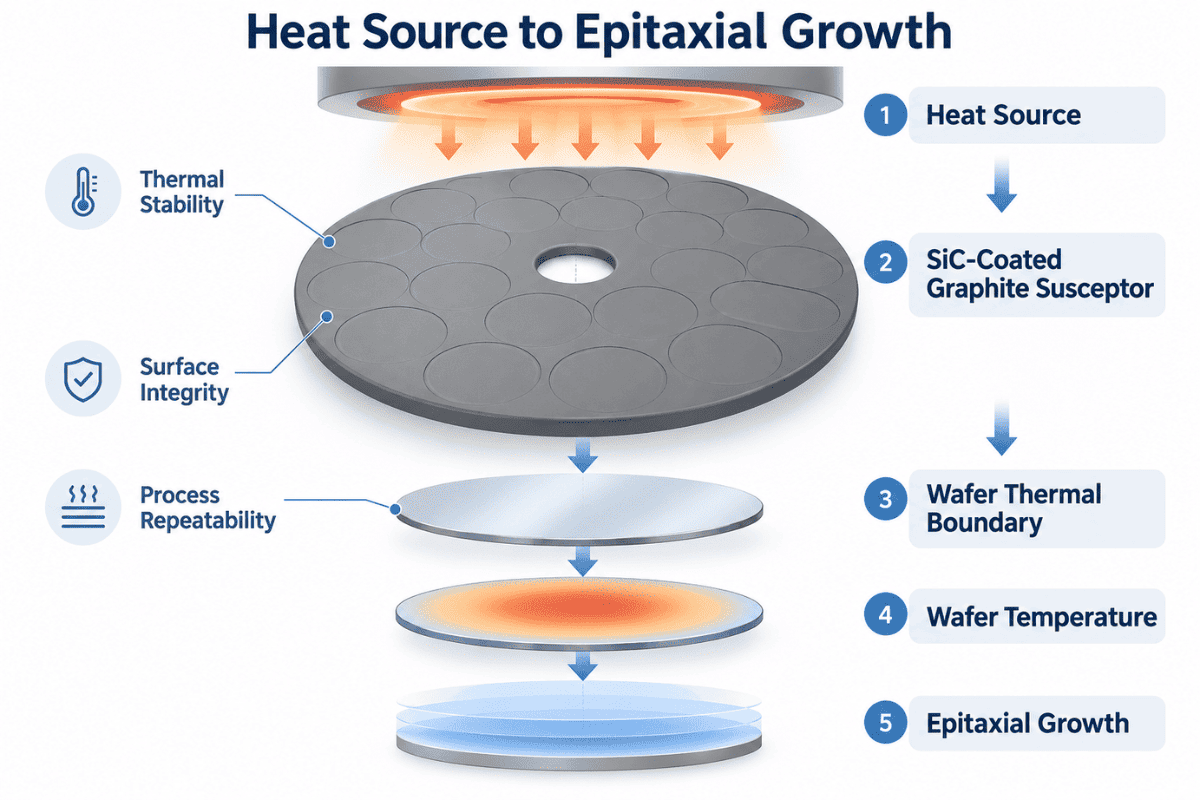
Each interface matters. If the susceptor becomes distorted, if pockets change dimension, if deposits accumulate unevenly or if the coating locally fails, the conditions experienced by the wafer may change even when the nominal reactor recipe remains unchanged.
This is why precision machining and coating quality are tightly connected. SGL Carbon emphasizes pocket profile, flatness, surface finish, purity and homogeneous SiC coating for silicon epitaxy susceptors and also links susceptor properties to epitaxial-layer quality.
A similar relationship exists in MOCVD. Wafer carriers rotate substrates through a controlled thermal and precursor field, and the thermal behavior of the carrier contributes to wafer temperature distribution. SGL Carbon notes that high-purity graphite, homogeneous SiC coatings and tight dimensional tolerances are used to control carrier performance in LED and GaN-related MOCVD applications.
It would therefore be inaccurate to claim that SiC coating alone “improves epitaxial yield.” The more defensible engineering conclusion is that a stable, well-designed SiC-coated graphite component helps maintain the thermal, chemical and contamination boundary conditions required for repeatable epitaxy.
That distinction is important for both technical accuracy and supplier qualification.
The underlying material concept is similar for silicon and SiC epitaxy, but the severity of the operating environment is different.
In silicon epitaxy, high-purity coated susceptors must maintain dimensional accuracy, thermal uniformity and a clean process surface. Commercial suppliers place strong emphasis on flatness, pocket geometry, machining tolerance and coating homogeneity because the susceptor forms part of the wafer-heating system.
SiC epitaxy typically places greater thermal and chemical stress on the hot zone. Chloride-based SiC growth, for example, may operate at temperatures around 1,570°C in published reactor studies. Under such conditions, coating degradation at localized hot spots becomes particularly relevant because changes in the susceptor surface can affect reproducibility over multiple runs.
The appropriate question is therefore not whether SiC coating is “better” for one process than another. The correct question is whether the coating architecture is compatible with the actual temperature, gas chemistry, thermal cycle, cleaning method and component geometry.
The same logic applies when evaluating alternative coatings such as TaC or when considering solid SiC components. Material selection should follow the process environment rather than a generic material hierarchy.
A technically meaningful specification begins with the reactor rather than with the coating.
The supplier should understand the epitaxy process, reactor configuration, wafer size, component geometry, operating temperature, process gases and cleaning chemistry before defining the graphite and coating requirements. The component drawing should then establish pocket geometry, flatness, critical dimensions and surface finish. Only after these requirements are understood should coating thickness, uniformity, roughness and inspection criteria be finalized.
This approach changes the RFQ from a commodity request—
“Quote a SiC-coated graphite susceptor.”
—to an engineering specification built around the actual process.
For epitaxy components, the objective is not simply to maximize coating lifetime. The objective is to maintain a component that supports stable wafer temperature, controlled contamination, low particle risk, dimensional consistency and repeatable growth conditions throughout its intended service period.
1. Why is graphite coated with silicon carbide in epitaxy?
Graphite provides machinability and useful thermal characteristics, while CVD SiC provides a chemically stable, high-purity process-facing surface. The combination allows complex graphite susceptors to operate in demanding semiconductor environments.
2.Why not use bare graphite?
Bare graphite can interact with reactive gases, expose impurities, roughen or generate particles over time. A dense SiC coating separates the graphite from the process atmosphere.
3.Does SiC coating eliminate contamination?
No. It reduces graphite-related contamination risk when the coating remains intact, but contamination can also originate from gases, chamber surfaces, deposits, handling and other reactor components.
4.Does the SiC coating affect thermal performance?
Yes. The coating, graphite substrate, component geometry and surface condition together influence the thermal boundary between the susceptor and wafer. The coating should therefore be evaluated as part of the complete component.
5.What information should be included in an RFQ?
A useful RFQ should include the reactor model, process type, wafer size, component drawing, operating temperature, process and cleaning gases, graphite requirements, coating specification, critical tolerances, surface finish, inspection criteria and required quantity.
References
1. SGL Carbon. Graphite Susceptors and Components for Silicon and SiC Epitaxy.
2. SGL Carbon. SIGRAFINE® SiC Coating.
3. Mersen. Semiconductor Process Equipment — Ultra-Pure Graphite Coated with Silicon Carbide. Pedersen, H. et al. SiC Epitaxy Growth Using Chloride-Based CVD. Journal of Crystal Growth.
+86-579-87223657
Wangda Road, Ziyang Street, Wuyi County, Jinhua City, Zhejiang Province, China