




QR Code

Products
Contact Us


Fax
+86-579-87223657

Email

Address
Wangda Road, Ziyang Street, Wuyi County, Jinhua City, Zhejiang Province, China



Silicon nitride (Si₃N₄) ceramics have emerged as one of the most versatile advanced structural ceramics for demanding thermal, mechanical, and chemical environments. Combining high flexural strength, low thermal expansion, outstanding thermal-shock resistance, and excellent chemical durability, Si₃N₄ components are widely adopted in semiconductor process equipment, high-power packaging substrates, precision industrial tooling, and high-temperature mechanical systems.
At VeTek Semiconductor, we engineer high-performance silicon nitride ceramics tailored for semiconductor and power-electronics customers. Our materials deliver a balanced combination of mechanical strength, thermal stability, and process compatibility—whether the requirement is a structural fixture in a semiconductor chamber or a high-reliability ceramic substrate platform.
VeTek Si₃N₄ ceramics offer a unique set of properties that make them ideal for harsh operating conditions:
• High flexural strength and elastic modulus for reliable load-bearing structural use
• Low thermal expansion coefficient (~2.6 × 10⁻⁶/°C), ensuring dimensional stability under thermal cycling
• Strong thermal-shock resistance (rated to approximately 800 °C ΔT class performance)
• Near-zero water absorption and dense microstructure for reliable sealing and cleanliness
• Good fracture toughness relative to many technical ceramics, improving damage tolerance
• High volume resistivity and electrical insulation capability for process and packaging environments
• Chemical resistance to common acids and alkaline media under specified test conditions
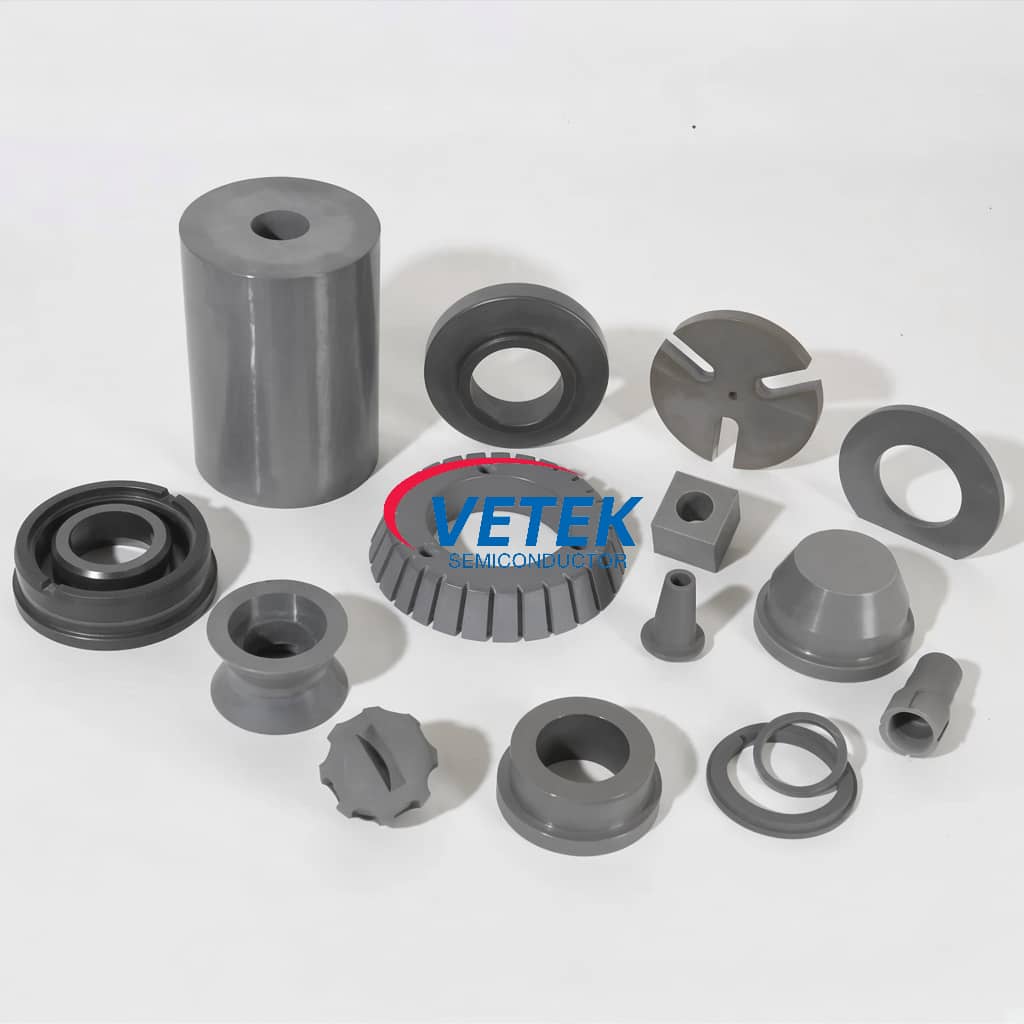
Typical properties of VeTek Silicon Nitride ceramic material are summarized below:
|
Property |
Unit / Standard |
Typical Value (Si₃N₄) |
|
Material |
— |
Si₃N₄ |
|
Color |
— |
Gray |
|
Purity |
— |
> 90% |
|
Density |
g/cm³ (ASTM C20) |
3.2 |
|
Water Absorption |
% (ASTM C373) |
0 |
|
HV Hardness |
GPa (ASTM C1327) |
13.9* |
|
Flexural Strength |
MPa (ASTM C1161) |
610 |
|
Elastic Modulus |
GPa (ASTM C1198) |
290 |
|
Poisson’s Ratio |
— (ASTM C1198) |
0.28 |
|
Fracture Toughness |
MPa·m¹/² (ASTM C1421) |
5 |
|
Thermal Expansion (RT) |
×10⁻⁶/°C (ASTM C372) |
2.6 |
|
Thermal Conductivity |
W/(m·K) (ASTM C408) |
20 |
|
Thermal Shock Resistance |
°C |
800 |
|
Volume Resistivity |
Ω·cm (25 °C) |
1 × 10¹⁴ |
|
Corrosion (60% HNO₃, 90 °C) |
wt loss mg/cm²/d |
1 |
|
Corrosion (95% H₂SO₄, 95 °C) |
wt loss mg/cm²/d |
0.4 |
|
Corrosion (30% NaOH, 80 °C) |
wt loss mg/cm²/d |
0.36 |
* Hardness value shown as typical for sintered Si₃N₄ grade; exact HV depends on microstructure and test load. Other properties are representative and may be adjusted by grade and process.
Silicon nitride components from VeTek are used across semiconductor, power-electronics, and industrial high-temperature systems. Beyond our core semiconductor focus, Si₃N₄ has proven value in multiple industrial sectors:
(1). Semiconductor Process Equipment
Si₃N₄ is widely used for fixtures, supports, chamber-related hardware, wafer transfer arms, heater substrates, rotating shafts, and support fixtures. Its low CTE, high fracture toughness, and resistance to aggressive process chemistries make it ideal for epitaxy, RTP, ion implantation, and high-load handling systems. The material maintains dimensional accuracy under repeated thermal cycling.
High-reliability ceramic substrates and structural parts for power modules (including Si₃N₄ AMB platforms) further leverage its electrical insulation and thermal performance.
(2). Metallurgical Industry
Sintered silicon nitride exhibits a low linear expansion coefficient and excellent thermal-shock resistance (second only to quartz and glass-ceramics). Its low friction coefficient and self-lubricating properties make it an outstanding wear-resistant material. High mechanical strength, low high-temperature creep, superior electrical insulation, and resistance to all inorganic acids except hydrofluoric acid (plus certain alkalis) further expand its utility.
In aluminum, copper, and zinc refining: thermocouple protection tubes, furnace linings, ladles, crucibles, pumps, pipes, valves, and casting molds.
In steelmaking and continuous casting: separation rings for horizontal continuous casting that stabilize the solid-liquid interface and improve billet quality.
In ironmaking: Si₃N₄ and SiAlON-bonded silicon carbide refractories are increasingly used in large blast furnaces due to excellent slag resistance and oxidation resistance.
(3). Chemical & Metal Heat-Treatment Industries
Silicon nitride ceramics serve as robust fixtures and heating-element supports in vacuum heat treatment. In induction heating tests, Si₃N₄ arbors used to hold gears have withstood repeated rapid heating to 900 °C followed by oil quenching—thousands of cycles with only minor wear—demonstrating outstanding thermal-shock and wear performance.
(4). Mechanical Engineering & Automotive
Precision shafts, rollers, bearings, and wear-resistant mechanical elements benefit from Si₃N₄’s hardness (second only to diamond and cubic boron nitride in many grades), self-lubrication, and high-temperature strength. In automotive applications, silicon nitride contributes to energy-efficient engine designs: lower density than metals, reduced inertia, higher operating temperatures enabling more complete combustion, lower emissions, and fuel savings. Research into all-ceramic engines continues to advance.
Welding, brazing, and induction-heating fixtures and nozzles also exploit the material’s thermal stability and chemical inertness.
(5). Aerospace
Porous silicon nitride combines the intrinsic advantages of dense Si₃N₄ (high strength, toughness, creep resistance, thermal-shock resistance) with low density, low dielectric constant, and low dielectric loss. These characteristics make it suitable for radomes on high-speed aircraft (Mach 6–7 class), where strength, rain-erosion resistance, and thermal-shock performance are critical. Silicon nitride materials have also been incorporated into next-generation aero-engine components to address high-temperature challenges and weight reduction.
(6). Medical Applications
Biocompatible grades of silicon nitride have been explored for artificial joints (e.g., ceramic-on-ceramic hip prostheses), leveraging high strength, wear resistance, and chemical stability.
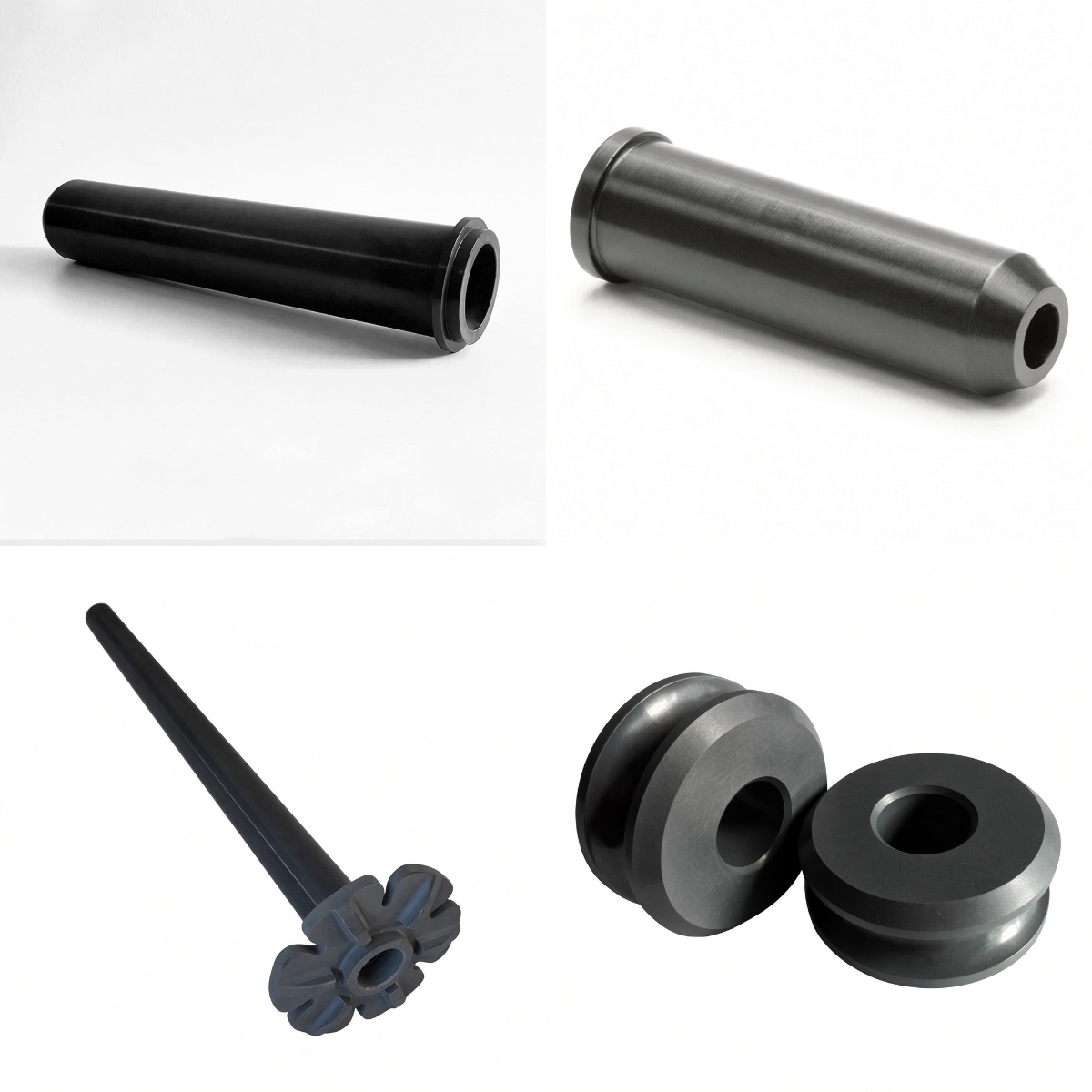
VeTek supplies silicon nitride in a wide range of standard and custom geometries:
• Plates, blocks, and substrate blanks
• Rods, tubes, and shafts
• Rings, nozzles, and precision machined fixtures
• Fully custom geometries based on customer drawings (CNC finishing available)
VeTek Semiconductor focuses on high-performance ceramics and process components for semiconductor and power-electronics customers. For Si₃N₄, this means:
• Material grades selected for strength, thermal-shock capability, and chemical durability
• Precision machining and finishing to meet tight geometric and surface requirements
• Support for both standard shapes and fully custom parts for tool and module integration
• A broader advanced-ceramics portfolio including AlN, Al₂O₃, porous SiC, and related materials
Silicon nitride ceramics continue to expand their role across semiconductor manufacturing, metallurgy, chemical processing, automotive, aerospace, and medical fields. Their combination of high strength, low thermal expansion, exceptional thermal-shock resistance, wear performance, and chemical inertness addresses challenges that few other materials can meet simultaneously.
Whether you need structural fixtures for semiconductor chambers, high-reliability substrates for power modules, or precision components for high-temperature industrial systems, VeTek Silicon Nitride ceramics provide a proven, high-performance solution.
+86-579-87223657
Wangda Road, Ziyang Street, Wuyi County, Jinhua City, Zhejiang Province, China