








QR Code

Products
Contact Us


Fax
+86-579-87223657

Email

Address
Wangda Road, Ziyang Street, Wuyi County, Jinhua City, Zhejiang Province, China



Silicon carbide (SiC) is one of the most important semiconductor materials of the 21st century. It enables power electronics that are more efficient, more compact, and more durable than silicon-based devices. Electric vehicles, solar inverters, and 5G base stations all depend on SiC. But before a SiC device can be manufactured, a SiC crystal must be grown. And before a crystal can be grown, a SiC crystal growth furnace must be designed, built, and operated with extraordinary precision. Inside the furnace, a process called Physical Vapor Transport (PVT) takes place. The PVT process is the dominant method for growing bulk SiC crystals. It involves the sublimation of a solid SiC source material, the transport of the vapor species through a temperature gradient, and the deposition of those species onto a seed crystal to form a single crystal boule.
The question of how PVT works inside a SiC crystal growth furnace is a question of thermodynamics, mass transport, and crystal growth kinetics. The process takes place at temperatures exceeding 2,000°C, under controlled pressure, and in a carefully designed thermal environment. Every parameter—temperature, pressure, gas composition, and crucible geometry—affects the quality of the resulting crystal. Understanding the PVT process is essential for anyone involved in the design, operation, or procurement of SiC crystal growth furnaces. This article will provide a detailed technical explanation of the PVT process, covering the key stages, the critical parameters, and the design features of the furnace that enable the process. We will also provide detailed specifications for our SiC crystal growth furnaces from our factory at WuYi TianYao New Material Tech.Co.,Ltd.
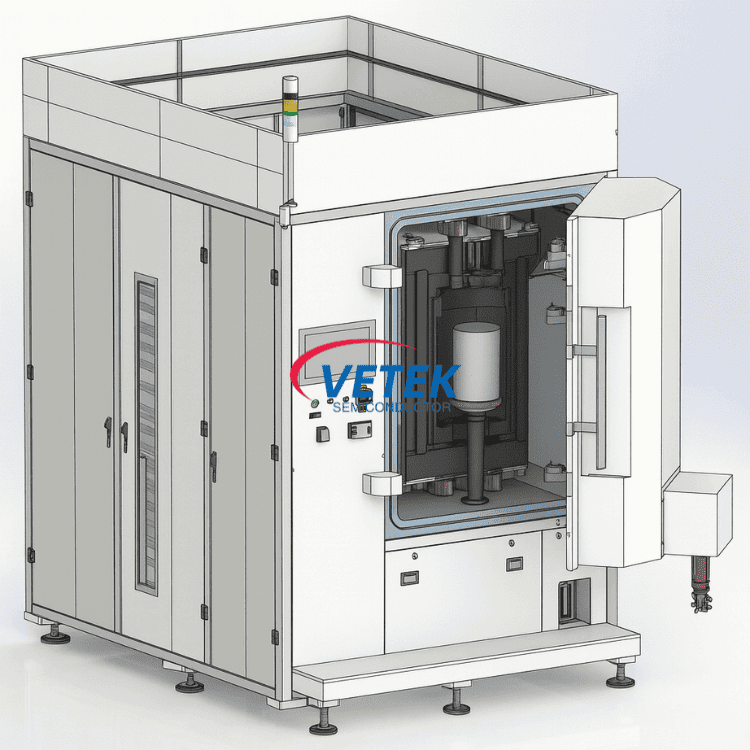
The PVT method, or Physical Vapor Transport, is a technique for growing bulk single crystals from a vapor phase. It is the primary method for producing SiC crystals for the semiconductor industry. The method is sometimes referred to as the modified Lely method, after the Dutch scientist Jan Anthony Lely who first demonstrated the growth of SiC crystals from the vapor phase in the 1950s. The PVT method is used for SiC because SiC does not melt congruently. Unlike silicon, which can be melted and solidified to form a crystal, SiC decomposes before it melts. This means that traditional melt-growth techniques, such as the Czochralski method, cannot be used. The PVT method bypasses the melting step by sublimating a solid SiC source and depositing the vapor onto a seed crystal. The table below compares the PVT method with other crystal growth methods.
| Method | Principle | Applicable Materials | Typical Growth Rate | Typical Crystal Size |
| PVT | Sublimation and deposition | SiC, AlN | 0.1 - 1 mm/h | 150 - 300 mm diameter |
| Czochralski | Melt pulling | Si, GaAs | 10 - 100 mm/h | 200 - 450 mm diameter |
| Bridgman | Directional solidification | GaAs, InP | 1 - 10 mm/h | 50 - 150 mm diameter |
| HVPE | Vapor phase epitaxy | GaN, SiC | 10 - 100 µm/h | Thin films |
At WuYi TianYao New Material Tech.Co.,Ltd, our factory specializes in the design and manufacture of SiC crystal growth furnaces based on the PVT method. We have extensive experience in thermal design, vacuum systems, and process control. Our furnaces are used by leading SiC crystal manufacturers to produce high-quality crystals for power electronics and RF applications.
The PVT process inside a SiC crystal growth furnace unfolds in several distinct stages. The first stage is heating. The furnace is evacuated and then backfilled with an inert gas, typically argon, at a controlled pressure. The heating elements are activated, and the temperature is raised to the growth temperature, which is typically between 2,000°C and 2,500°C. The second stage is sublimation. At the growth temperature, the SiC source material, which is typically a high-purity SiC powder or a solid SiC charge, begins to sublimate. The sublimation produces vapor species, primarily silicon (Si), silicon carbide (SiC), and silicon dicarbide (SiC2). The third stage is transport. The vapor species migrate from the source, which is at a higher temperature, to the seed crystal, which is at a lower temperature. The transport is driven by the temperature gradient and the concentration gradient. The fourth stage is deposition. The vapor species deposit onto the seed crystal, forming a single crystal boule. The growth proceeds layer by layer, with the crystal structure of the seed determining the orientation of the boule. The fifth stage is cooling. After the growth is complete, the furnace is cooled slowly to prevent thermal stress and cracking. The table below summarizes the stages of the PVT process.
| Stage | Temperature | Pressure | Key Phenomena |
| Heating | Room temp to 2,000°C | Vacuum, then Argon | Outgassing, thermal stabilization |
| Sublimation | 2,000°C - 2,500°C | 1 - 100 mbar | SiC source decomposes to Si, SiC, SiC2 |
| Transport | Gradient 2,000°C - 2,300°C | 1 - 100 mbar | Vapor migration from source to seed |
| Deposition | 2,000°C - 2,300°C | 1 - 100 mbar | Crystal growth on seed |
| Cooling | 2,000°C to room temp | Argon | Stress relief, crystal stabilization |
At our factory, we design our SiC crystal growth furnaces to precisely control each stage of the PVT process. We use advanced heating elements, thermal insulation, and control systems to ensure that the temperature and pressure are maintained within tight tolerances. Our goal is to provide our customers with furnaces that produce high-quality crystals with high yield and repeatability.
The temperature gradient is the driving force of the PVT process. It is the difference in temperature between the source material and the seed crystal that causes the vapor species to migrate and deposit. The temperature gradient must be carefully controlled to achieve the desired growth rate, crystal quality, and polytype. If the gradient is too steep, the growth rate may be too high, leading to defects. If the gradient is too shallow, the growth rate may be too low, and the process may be inefficient. The temperature gradient is controlled by the design of the furnace, specifically the geometry of the heating elements, the thermal insulation, and the crucible. The furnace typically uses a cylindrical graphite crucible that is heated by induction or resistance heating. The source is placed at the bottom of the crucible, and the seed is placed at the top. The heating is designed to create a temperature difference of 50-200°C between the source and the seed. The table below summarizes the key parameters for temperature gradient control.
| Parameter | Typical Value | Impact on Crystal Growth |
| Source Temperature | 2,200°C - 2,500°C | Determines sublimation rate |
| Seed Temperature | 2,100°C - 2,300°C | Determines deposition rate |
| Temperature Gradient | 50°C - 200°C | Determines growth rate and quality |
| Axial Gradient | 10°C/cm - 50°C/cm | Controls mass transport |
| Radial Gradient | < 5°C/cm | Controls crystal uniformity |
At WuYi TianYao New Material Tech.Co.,Ltd, our factory uses advanced thermal simulation software to design the temperature profile of our SiC crystal growth furnaces. We optimize the heating element geometry and the insulation configuration to achieve a uniform radial temperature and a controlled axial gradient. Our furnaces are equipped with multiple temperature sensors and closed-loop control systems to maintain the temperature profile throughout the growth cycle.
The pressure inside the SiC crystal growth furnace is a critical parameter that affects the sublimation rate, the transport rate, and the crystal quality. The pressure is typically in the range of 1 to 100 mbar, depending on the specific process. The pressure is controlled by a vacuum pump and a gas flow controller. The pressure affects the mean free path of the vapor species and the rate of collision between them. At low pressure, the mean free path is long, and the transport is primarily ballistic. At higher pressure, the mean free path is shorter, and the transport is more diffusive. The pressure also affects the stoichiometry of the vapor phase. At different pressures, the ratio of Si to SiC2 in the vapor phase changes, which affects the composition of the growing crystal. The table below summarizes the effect of pressure on the PVT process.
| Pressure Range | Transport Mechanism | Growth Rate | Crystal Quality |
| 1 - 10 mbar | Ballistic | Low | High (low defect density) |
| 10 - 50 mbar | Transition | Moderate | Good |
| 50 - 100 mbar | Diffusive | High | Moderate (higher defect density) |
| > 100 mbar | Diffusive | Very High | Low (polycrystalline growth) |
At our factory, we design our SiC crystal growth furnaces with precise pressure control systems. We use mass flow controllers to regulate the argon flow and a throttle valve to control the pumping speed. The pressure is monitored by a capacitance manometer and controlled by a closed-loop system. Our goal is to provide our customers with the ability to optimize the pressure for their specific growth process.
The quality of a SiC crystal is assessed by several criteria, including the polytype, the micropipe density, the dislocation density, and the resistivity. The polytype is the crystal structure of the SiC. The most common polytypes are 4H-SiC and 6H-SiC. 4H-SiC is preferred for power electronics because of its higher electron mobility. The micropipe density is a measure of the hollow defects that can cause device failure. The dislocation density is a measure of the line defects that can affect device performance. The resistivity is a measure of the electrical conductivity of the crystal. The table below summarizes the quality criteria for SiC crystals.
| Quality Criterion | Typical Target | Measurement Method |
| Polytype | 4H-SiC (100%) | X-ray diffraction |
| Micropipe Density | < 1 cm⁻² | Optical microscopy, etching |
| Dislocation Density | < 10⁴ cm⁻² | X-ray topography, etching |
| Resistivity | 0.015 - 0.025 Ω·cm (n-type) | Hall effect, four-point probe |
| Surface Roughness | < 0.5 nm RMS | Atomic force microscopy |
At WuYi TianYao New Material Tech.Co.,Ltd, our factory works closely with our customers to optimize the crystal quality. We provide furnaces with advanced process control capabilities, including real-time temperature and pressure monitoring, and data logging for process analysis. We also offer technical support and process development services to help our customers achieve their quality targets.
The key specifications for a SiC crystal growth furnace include the maximum temperature, the temperature uniformity, the vacuum level, the pressure control range, the crucible size, and the heating power. The table below provides a summary of the typical specifications for our SiC crystal growth furnaces.
| Specification | Range | Notes |
| Max Temperature | 2,500°C | For SiC sublimation |
| Temperature Uniformity | +/- 5°C (radial) | For uniform crystal growth |
| Vacuum Level | 10⁻³ mbar | For initial evacuation |
| Pressure Control Range | 0.1 - 1,000 mbar | For process optimization |
| Crucible Size | 4" - 8" diameter | For different crystal sizes |
| Heating Power | 30 - 100 kW | Induction or resistance |
| Control System | PLC with PID control | For precise parameter control |
| Data Logging | Yes | For process analysis and traceability |
At our factory, we manufacture SiC crystal growth furnaces to meet these specifications and more. We can customize the furnace to suit specific crystal sizes, temperature profiles, and process requirements. Our engineering team can assist with the selection process and provide detailed technical data for your project.
Question 1: What is the typical growth rate for SiC crystals using the PVT method?
Answer: The typical growth rate for SiC crystals using the PVT method is 0.1 to 1 mm per hour. The growth rate depends on the temperature gradient, the pressure, and the source-to-seed distance. Higher growth rates can be achieved, but they often result in lower crystal quality. Our factory can help you optimize the growth rate for your specific quality requirements.
Question 2: What is the difference between 4H-SiC and 6H-SiC?
Answer: 4H-SiC and 6H-SiC are different polytypes of silicon carbide. They have different crystal structures, which result in different electrical properties. 4H-SiC has higher electron mobility and is preferred for power electronics. 6H-SiC has higher thermal conductivity and is used for some RF applications. The polytype is determined by the growth conditions, particularly the temperature and the seed orientation.
Question 3: What are micropipes and how can they be reduced?
Answer: Micropipes are hollow defects that run through the crystal. They are caused by the propagation of defects from the seed or by the incorporation of foreign particles during growth. Micropipes can be reduced by using a high-quality seed crystal, by maintaining a stable temperature gradient, and by reducing the growth rate. Our furnaces are designed to minimize temperature fluctuations and to provide a stable growth environment.
Question 4: How long does a typical SiC crystal growth run take?
Answer: A typical SiC crystal growth run takes 3 to 7 days, depending on the desired crystal length and the growth rate. The process includes heating, growth, and cooling stages. The growth stage itself is the longest, typically taking 2 to 5 days. Our furnaces are designed for reliable, long-duration operation with minimal downtime.
Question 5: What is the maximum crystal size that can be grown in your furnaces?
Answer: Our standard furnaces can grow crystals up to 8 inches (200 mm) in diameter. We can also custom-design furnaces for larger crystal sizes. The maximum crystal size depends on the crucible size, the heating power, and the thermal design of the furnace. Our engineering team can work with you to determine the optimal furnace configuration for your target crystal size.
The PVT process inside a SiC crystal growth furnace is a remarkable feat of engineering. It involves the precise control of temperature, pressure, and mass transport to grow a single crystal from a vapor phase. The furnace must provide a stable thermal environment, a controlled pressure, and a reliable control system. At WuYi TianYao New Material Tech.Co.,Ltd, our factory has the expertise and the experience to design and manufacture SiC crystal growth furnaces that meet the most demanding requirements. We use advanced thermal simulation, precision manufacturing, and rigorous testing to ensure that our furnaces deliver reliable performance and high-quality crystal growth. Whether you are producing SiC crystals for power electronics, RF devices, or research, we can provide the furnace you need.
Our commitment to quality and customer satisfaction has made us a trusted partner for SiC crystal manufacturers around the world. We invite you to contact us to discuss your SiC crystal growth furnace requirements. We can provide technical data, process support, and customized solutions. Let us help you achieve your crystal growth goals.
Contact WuYi TianYao New Material Tech.Co.,Ltd today to discuss your SiC crystal growth furnace requirements and discover how our PVT furnaces can meet your production needs.
+86-579-87223657
Wangda Road, Ziyang Street, Wuyi County, Jinhua City, Zhejiang Province, China