
Tech &  solutions

01-05 VETEK | Application Boundaries and Selection Points of Solid SiC in Etching and High-Purity Scenarios

Industry

Semiconductor manufacturing (plasma etching, high-purity hot-zone parts)

Process

Plasma etching; chamber parts highly sensitive to interface delamination and particles

Solution

Solid SiC focus ring and related high-purity parts; boundary vs coated graphite solutions

Services

Application assessment, dimensional customization, sample on-tool verification, purity and lifetime technical support

Results

• No coating–substrate interface; lower delamination-type particle risk

• Strong plasma resistance; suited to critical parts such as focus rings

• Lifetime can reach 2000+ hour order under suitable processes

• Judge introduction by TCO, not unit price alone

Solid SiC is not a “more expensive coating substitute,” but another technical path for no-interface, plasma-resistant and ultra-long-lifetime scenarios. This article explains its application boundaries in etching and high-purity use, TCO comparison with coated graphite, and verification points for introduction.

When a line repeatedly sees coating delamination or particle climb on focus rings and similar positions, the issue is often not only “insufficient cleaning” or “a bad lot,” but whether the material form matches the plasma environment.

1. Why Are Critical Etching Parts More Often Selected in Solid SiC?

Core Conclusion: Plasma is unfriendly to the coating–substrate interface. Solid SiC is bulk β-SiC with no coating interface, eliminating delamination-type particle sources by structure; it also resists plasma erosion more strongly and suits critical parts such as focus rings that are directly exposed to plasma.

In epitaxy hot zones, coated graphite remains mainstream; in etch chambers, interface and erosion mechanisms differ, so material selection logic must change with them.

Structural and Service Differences

• Coated graphite: has a coating–graphite interface; long-term plasma or thermal stress carries delamination risk

• Solid SiC: bulk is SiC; no interface delamination path; purity can reach 5N–7N

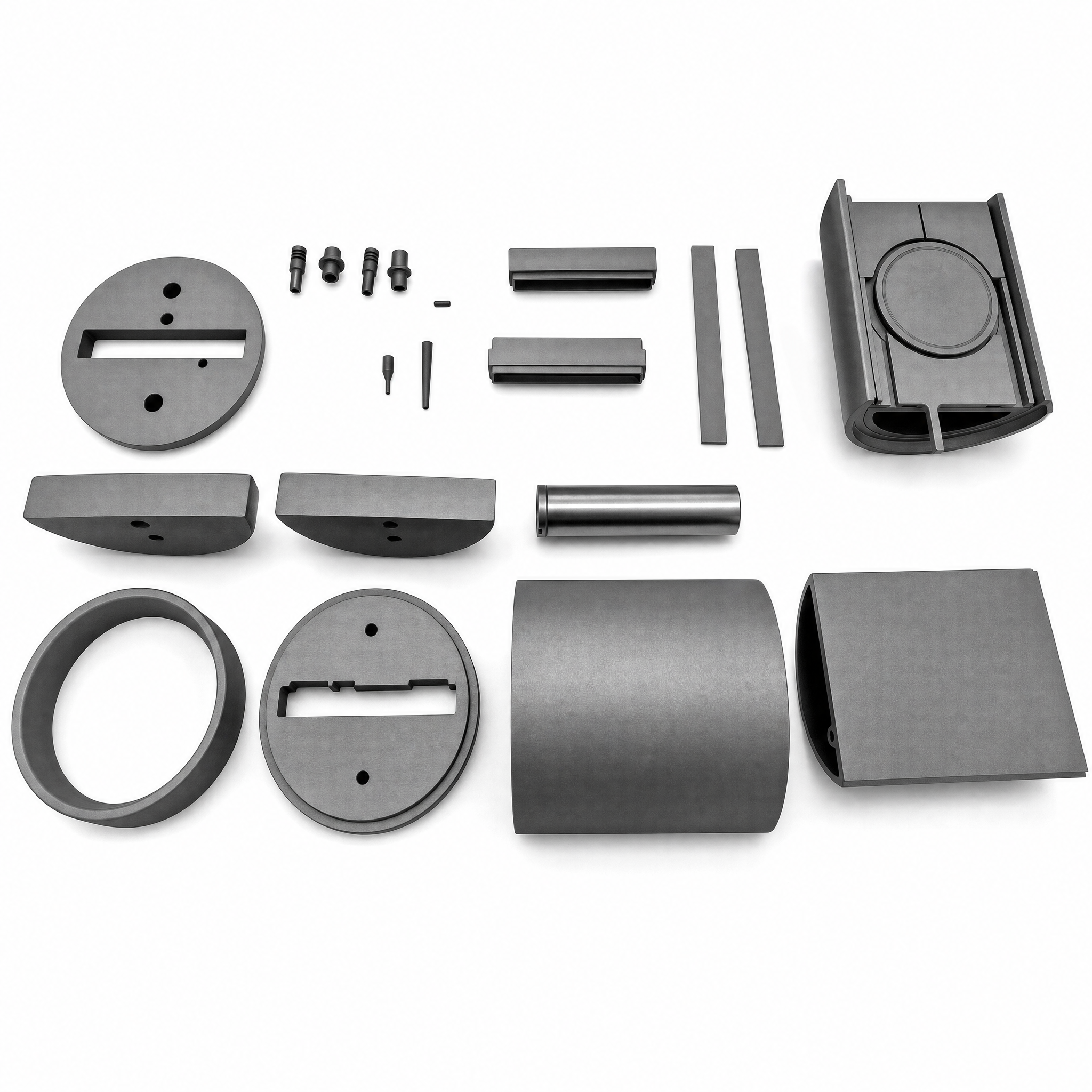
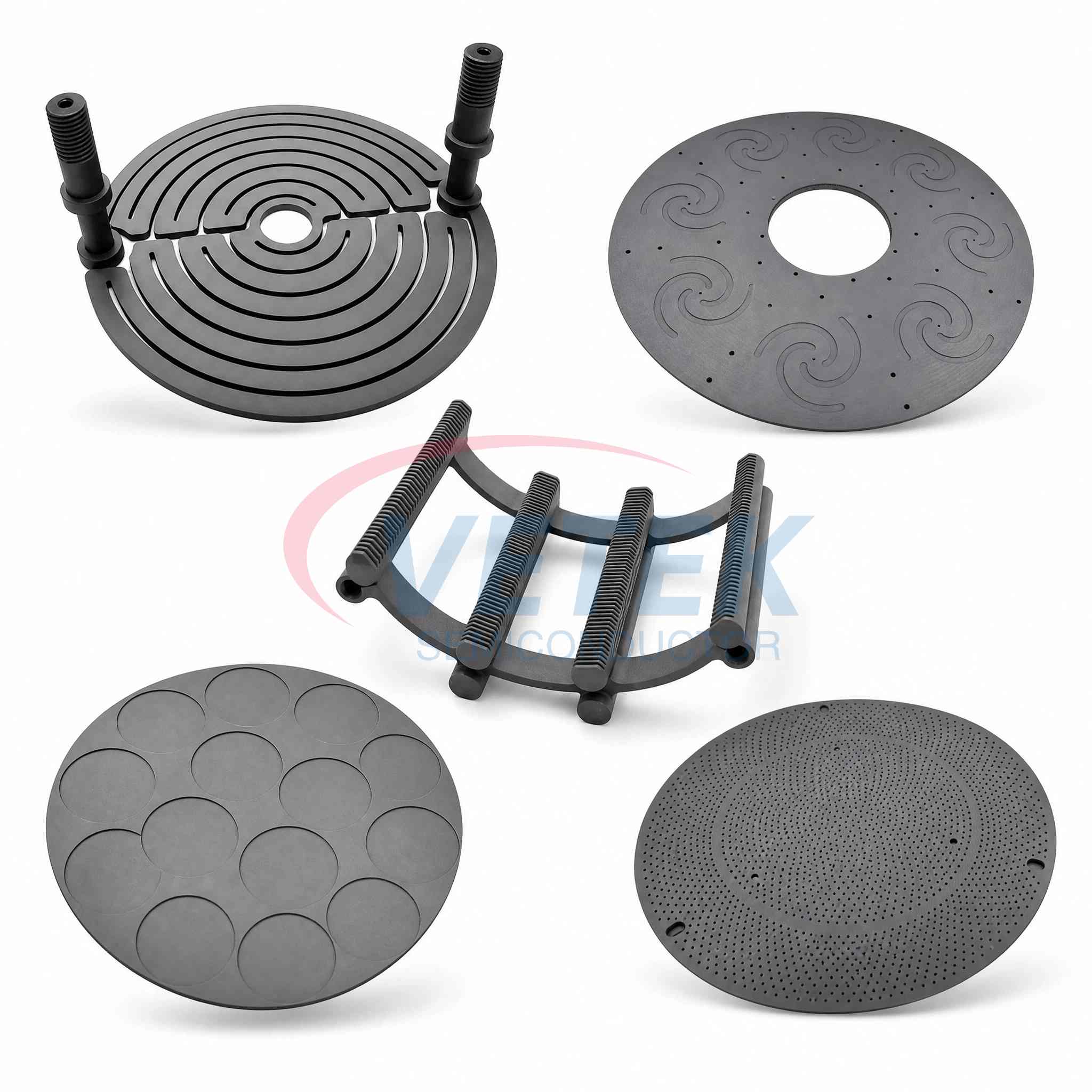
• Typical applications: focus ring, some showerheads, and chamber parts with very high particle and lifetime requirements

2. How to Compare TCO Between Solid SiC and Coated Graphite?

Core Conclusion: Do not compare purchase unit price alone. After folding replacement cycle, downtime and yield loss from particles into cost per run or per wafer, Solid SiC is often more favorable on high-load etch positions; on mild epitaxy trays, coated graphite usually remains the better balance.

TCO comparison should at least cover: part price, expected lifetime (runs or hours), planned downtime, unplanned particle-related downtime, scrap and logistics.

Brief Comparison

Dimension

Coated Graphite

Solid SiC

Interface delamination risk

Yes

None

Plasma resistance

Depends on coating condition

Stronger

Typical purchase cost

Lower

Higher

Better suited scenarios

Epitaxy susceptor, etc.

Etch focus ring, etc.

The table shows common engineering judgments; specific numbers must be calculated from plant lifetime and downtime cost.

3. What Should Be Verified When Introducing Solid SiC?

Core Conclusion: First confirm dimensional and thermal/electrical match, then verify particles, etch uniformity and actual lifetime in a small batch, and only then scale purchasing. Do not let “higher-grade material” replace on-tool data.

Recommended verification sequence:

1. Drawing/original dimensions match the chamber; tolerances allow install.

2. Purity and surface condition meet plant specs (reports can be required).

3. Small-batch on-tool: particles, critical process window dimensions, replacement cycle.

4. Compare under the same conditions with the existing coating solution, then decide the switch scope.

4. Case Study: Solid SiC Introduction Driven by Focus Ring Coating Delamination

Core Conclusion: When the failure mode is coating-interface delamination rather than simple surface deposition, more frequent cleaning or lot changes often treat symptoms only. Evaluating Solid SiC on positions directly exposed to plasma can structurally cut the delamination path.

Engineering Note:

An etch line long used coated graphite focus rings. Particles rose repeatedly in mid-to-late life; maintenance first responded with cleaning and lot changes—effective short term but with ever-shorter cycles. Failed-part analysis showed local coating delamination and interface exposure, highly overlapping the plasma-direct zone, not uniform surface-deposit contamination. The line then introduced Solid SiC samples at the same dimensions. Small-batch comparison showed: under the same process, particles were more stable and replacement cycles clearly longer; unit price was higher, but cost per run fell after accounting for downtime and yield loss. The decision point was not “Solid SiC is always better,” but that the failure mode already pointed to the interface—more cleaning on the coating path could not remove the root cause. This case shows: select Solid SiC when the failure mechanism matches its no-interface and plasma-resistance advantages; analyze first, then switch—more reliable than switching first and explaining later.

5. FAQ

1. Should epitaxy susceptors also move to Solid SiC?

In most cases, no. Epitaxy hot zones value thermal response and cost more; high-purity graphite + CVD SiC/TaC coating remains mainstream. Solid SiC is prioritized for etch and other interface- and plasma-sensitive positions.

2. Can Solid SiC lifetime always reach 2000 hours?

It is a reference order of magnitude under suitable processes. Actual results depend on plasma conditions, gases and maintenance strategy, and must follow plant verification.

3. Can coated graphite be swapped 1:1 for Solid SiC?

Dimensions can often be customized from the original part or drawing, but material and thermal/electrical behavior differ. On-tool verification is required; do not assume the process window is unchanged.

4. How to convince purchasing to accept a higher unit price?

Use same-condition comparison data: replacement cycle, particles, downtime counts—calculate cost per run or per wafer, not unit price alone.

5. How does this page work with the selection-decision cluster page?

Cluster page 2 gives the overall SiC/TaC/Solid SiC framework; this page details Solid SiC boundaries and verification path in etching and high-purity scenarios. Use them together.

6. Summary and Next Steps

The value of Solid SiC is no interface and plasma resistance—not a generic “higher end.” When the failure mode points to coating delamination or short etch-position lifetime, it is worth bringing into options via small-batch verification; when the scenario remains a conventional epitaxy hot zone, coated graphite is often still the better answer.

If you need to assess whether positions such as focus rings are suitable for Solid SiC introduction, you are welcome to contact the VeTek technical team. Dr. Xiao and the engineering team can assist with dimensional match, sample verification and TCO discussion.

For the overall selection framework, see: How to Select SiC Coating, TaC Coating or Solid SiC by Process Conditions; for the full system, see the pillar page 01 Performance Boundaries of CVD SiC, TaC and Solid SiC in Epitaxy and Etching Processes.


Main References and Data Sources

1. VeTek Semiconductor internal engineering and etch-customer application practice.

2. Boundary notes on Solid SiC vs coating solutions in the CVD Coating Consumables Selection Engineering Handbook for Semiconductor Epitaxy & Etching Equipment.

3. VeTek official website product and technical materials: https://www.veteksemicon.com/silicon-carbide-coating

Note: Lifetime and TCO figures in the text are typical engineering references; actual values follow plant verification and cost calculation.

Author: VeTek Semiconductor Technical Engineering Team (completed under the guidance of Dr. Xiao)

For further technical discussion or sample evaluation, please contact us via the official website.

X
We use cookies to offer you a better browsing experience, analyze site traffic and personalize content. By using this site, you agree to our use of cookies. Privacy Policy
RejectAccept