





QR Code

Products
Contact Us


Fax
+86-579-87223657

Email

Address
Wangda Road, Ziyang Street, Wuyi County, Jinhua City, Zhejiang Province, China



In semiconductor manufacturing, the Chemical Mechanical Planarization (CMP) process is the core stage for achieving wafer surface planarization, directly determining the success or failure of subsequent lithography steps. As the critical consumable in CMP, the performance of the Polishing Slurry is the ultimate factor in controlling Removal Rate (RR), minimizing defects, and enhancing overall yield.
This guide provides a systematic analysis of the CMP slurry technical framework and explores how to maintain process stability in complex production environments to achieve cost reduction and efficiency gains.
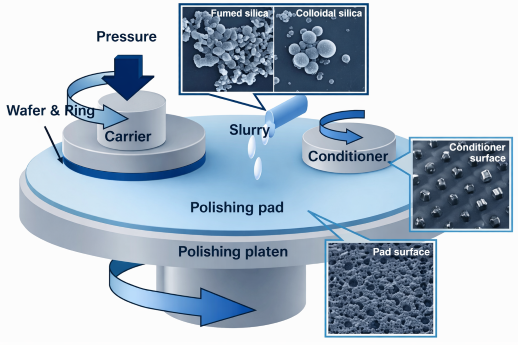
I. Typical Composition of CMP Slurry
A typical CMP slurry is a synergistic product of chemical action and physical mechanical force, consisting of the following primary components:
Abrasives: Provide mechanical removal capabilities. Common types include nano-sized Silica, Ceria, and Alumina.
Oxidizers: Enhance chemical reaction rates by oxidizing the metal surface; common examples include H₂O₂ or iron salts.
Chelating Agents: Form complexes with metal ions to facilitate dissolution.
Corrosion Inhibitors: Improve material selectivity by suppressing corrosion in non-target areas.
Additives: Include pH adjusters and dispersants used to maintain the reaction window and system stability.
The chemical and physical behaviors of the slurry must be precisely matched to the target material's characteristics; otherwise, defects such as scratches, dishing, and corrosion will be introduced.①
II. Slurry Systems for Different Materials
Because the material properties of various wafer film layers differ significantly, slurries must be customized and targeted:
|
Target Material Type |
Common Slurry Type |
Key Characteristics |
|
Silicon Dioxide(SiO₂) |
Colloidal Silica Slurry |
Moderate removal rate with high selectivity |
|
Copper(Cu) |
Composite system with oxidizers/chelators/inhibitors |
Susceptible to corrosion; primarily driven by chemical control |
|
Tungsten(W) |
Iron salt + Abrasive combination |
Requires suppression of corrosion and dishing; narrow process window |
|
Tantalum/Tantalum Nitride (Ta/TaN) |
High-selectivity slurry, often shared with Cu |
Typically paired with Copper processes; extremely high requirements for defect control |
|
Low-k Materials |
Abrasive-free chemical polishing system |
Prevents micro-cracks; high risk of film breakage |
III. Key Performance Metrics
When evaluating the potential for efficiency gains, the following technical indicators are vital:
Removal Rate (RR): The thickness of material removed per unit of time (nm/min), which directly impacts fab throughput.
Selectivity: The ratio of the removal rate of the target material to that of adjacent materials; higher selectivity better protects non-target layers.
Within-Wafer Non-Uniformity (WIWNU): Measures the consistency of planarization across the wafer surface.
Defectivity: Includes critical yield-killing metrics such as scratches and micro-particle residue.Slurry Stability: The ability of the slurry to resist striation, agglomeration, or sedimentation during storage and use.
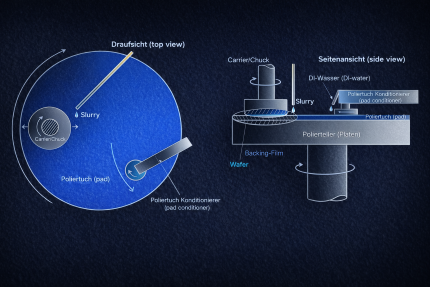
IV.Industry Best Practices for Improving Process Stability
To achieve long-term "cost reduction and efficiency enhancement," leading semiconductor enterprises focus on the following stability management practices:
Precision Balance of Chemical and Mechanical Forces: By finely tuning the ratio of abrasives to chemical components, reaction equilibrium is maintained at the molecular level, reducing dishing defects at the source.
Fluid Stability and Filtration Management: Rigorous control of pH fluctuations within the slurry circulation system, combined with high-efficiency filtration technology, prevents scratch volatility caused by particle agglomeration.
Customized Process Matching: Specific slurries are developed for varying physical hardnesses (e.g., high-hardness SiC or fragile low-k materials) to maximize the process window.
Consistency Monitoring Standards: Establishing a strict Batch Control Strategy ensures that key metrics like RR and WIWNU remain consistent throughout mass production.
Author:Sera-Lee
Reference:
①CMP Slurry Selection: A Materials Perspective – AZoM
②Chemical Mechanical Planarization Slurry Chemistry Overview – Entegris
+86-579-87223657
Wangda Road, Ziyang Street, Wuyi County, Jinhua City, Zhejiang Province, China