





QR Code

Products
Contact Us


Fax
+86-579-87223657

Email

Address
Wangda Road, Ziyang Street, Wuyi County, Jinhua City, Zhejiang Province, China



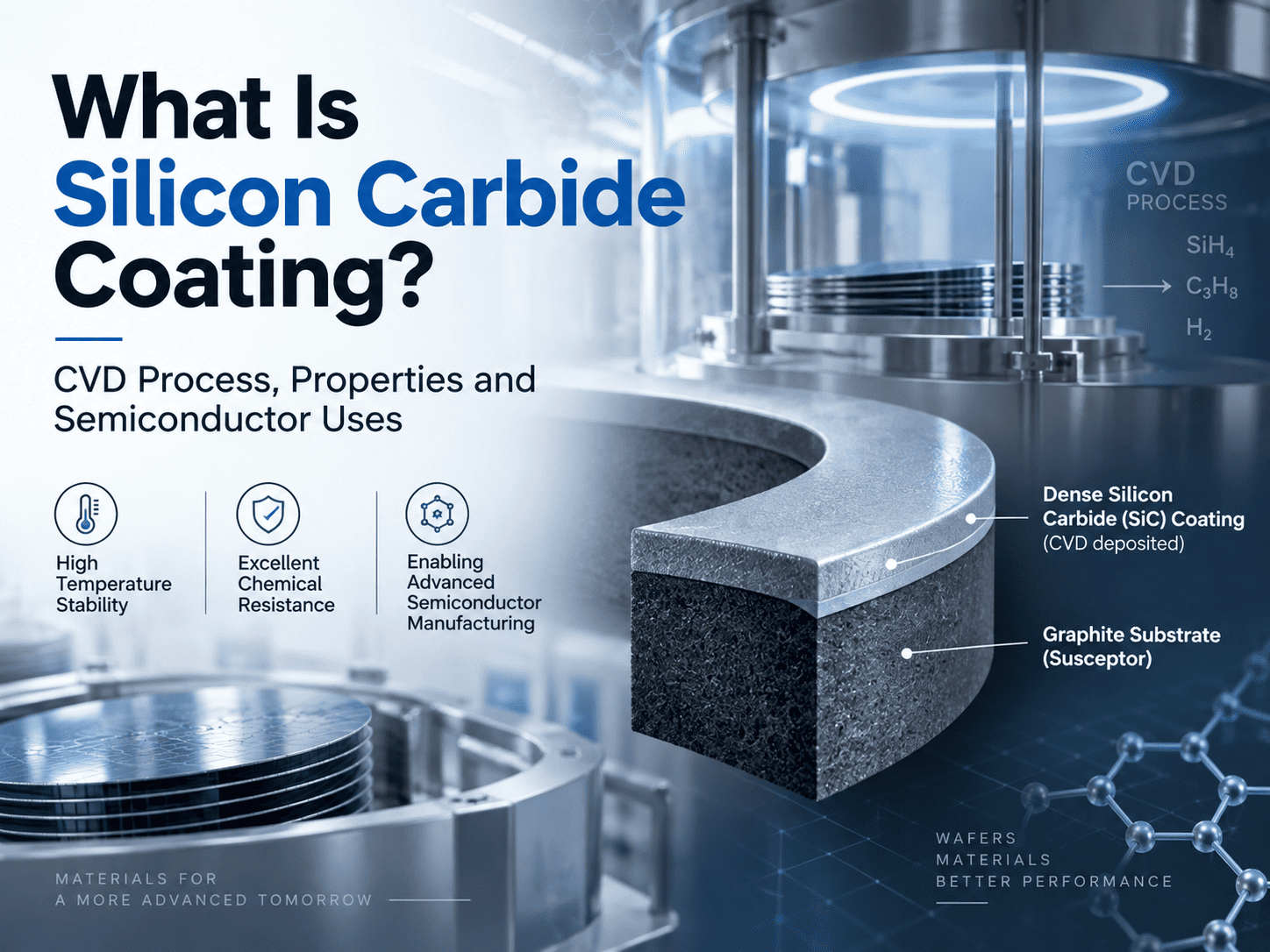
In the world of wide-bandgap (WBG) semiconductors, if the advanced manufacturing process is the "soul," the graphite susceptor is the "backbone," and its surface coating is the critical "skin." This coating, typically only dozens of microns thick, dictates the service life of expensive graphite consumables in harsh thermo-chemical environments. More importantly, it directly impacts the purity and yield of epitaxial growth.
Currently, two mainstream CVD (Chemical Vapor Deposition) coating solutions dominate the industry: Silicon Carbide (SiC) Coating and Tantalum Carbide (TaC) Coating. While both serve essential roles, their physical limits create a clear divergence when facing the increasingly rigorous demands of next-gen fabrication.
1. CVD SiC Coating: The Industry Standard for Mature Nodes
As the global benchmark for semiconductor processing, CVD SiC coating is the "go-to" solution for GaN MOCVD susceptors and standard SiC epitaxial (Epi) equipment. Its core advantages include:
Superior Hermetic Sealing: High-density SiC coating effectively seals the micropores of the graphite surface, creating a robust physical barrier that prevents carbon dust and substrate impurities from outgassing at high temperatures.
Thermal Field Stability: With a thermal expansion coefficient (CTE) closely matched to graphite substrates, SiC coatings remain stable and crack-free within the standard 1000°C to 1600°C epitaxial temperature window.
Cost-Efficiency: For the majority of mainstream power device production, SiC coating remains the "sweet spot" where performance meets cost-effectiveness.
With the industry's shift toward 8-inch SiC wafers, PVT (Physical Vapor Transport) crystal growth requires even more extreme environments. When temperatures cross the critical 2000°C threshold, traditional coatings hit a performance wall. This is where CVD TaC coating becomes a game-changer:
Unmatched Thermodynamic Stability: Tantalum Carbide (TaC) boasts a staggering melting point of 3880°C. According to research in the Journal of Crystal Growth, SiC coatings undergo "incongruent evaporation" above 2200°C—where silicon sublimates faster than carbon, leading to structural degradation and particle contamination. In contrast, TaC’s vapor pressure is 3 to 4 orders of magnitude lower than SiC, maintaining a pristine thermal field for crystal growth.
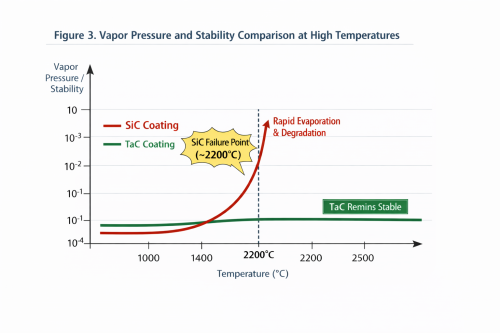
Superior Chemical Inertness: In reducing atmospheres involving H₂ (Hydrogen) and NH₃(Ammonia), TaC exhibits exceptional chemical resistance. Material science experiments indicate that TaC's mass loss rate in high-temp hydrogen is significantly lower than that of SiC, which is vital for reducing threading dislocations and improving interface quality in epitaxial layers.
3. Key Comparison: How to Choose Based on Your Process Window
Choosing between these two is not about simple replacement, but about precise alignment with your "Process Window."
|
Performance Metric |
CVD SiC Coating |
CVD TaC Coating |
Technical Significance |
|
Melting Point |
~2730°C (Sublimation) |
3880°C |
Structural integrity in extreme heat |
|
Max Recommended Temp |
2000°C - 2100°C |
2400°C+ |
Enables large-scale crystal growth |
|
Chemical Stability |
Good (Vulnerable to H₂ at high heat) |
Excellent (Inert) |
Determines process environment purity |
|
Vapor Pressure (2200°C) |
High (Silicon loss risk) |
Ultra-Low |
Controls "Carbon Inclusion" defects |
|
Core Applications |
GaN/SiC Epitaxy, LED Susceptors |
SiC PVT Growth, High-Voltage Epi |
Value chain alignment |
Yield optimization is not a single leap but a result of precise material matching. If you are struggling with "Carbon Inclusions" in SiC crystal growth or looking to slash your Cost of Consumables (CoC) by extending part life in corrosive environments, upgrading from SiC to TaC is often the key to breaking the deadlock.
As a dedicated developer of advanced semiconductor coating materials, VeTek Semiconductor has mastered both CVD SiC and TaC technological pathways. Our experience shows that there is no "best" material—only the most stable solution for a specific temperature and pressure regime. Through precision control of deposition uniformity, we empower our customers to push the boundaries of wafer yield in the era of 8-inch expansion.
Author:Sera Lee
References:
[1] "Vapor Pressure and Evaporation of SiC and TaC in High-Temperature Environments," Journal of Crystal Growth.
[2] "Cemical Stability of Refractory Metal Carbides in Reducing Atmospheres," Materials Chemistry and Physics.
[3] "Defect Control in Large-Size SiC Single Crystal Growth Using TaC-Coated Components," Materials Science Forum.
+86-579-87223657
Wangda Road, Ziyang Street, Wuyi County, Jinhua City, Zhejiang Province, China