








QR Code

Products
Contact Us


Fax
+86-579-87223657

Email

Address
Wangda Road, Ziyang Street, Wuyi County, Jinhua City, Zhejiang Province, China



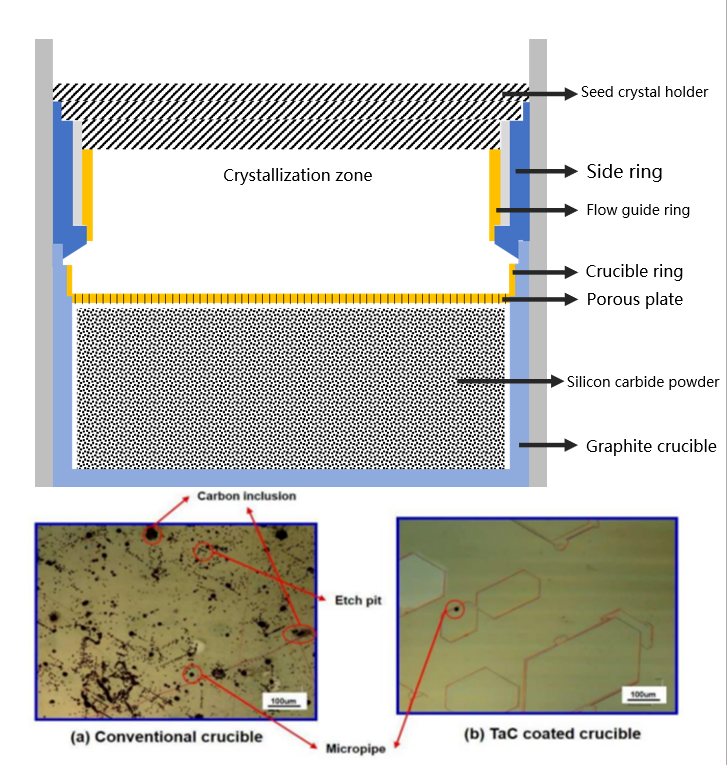
In the process of growing silicon carbide (SiC) crystals via the Physical Vapor Transport (PVT) method, the extreme high temperature of 2000–2500 °C is a “double-edged sword” — while it drives the sublimation and transport of source materials, it also dramatically intensifies impurity release from all materials within the thermal field system, especially trace metallic elements contained in conventional graphite hot-zone components. Once these impurities enter the growth interface, they will directly damage the core quality of the crystal. This is the fundamental reason why tantalum carbide (TaC) coatings have become a “mandatory option” rather than an “optional choice” for PVT crystal growth.
1. Dual Destructive Pathways of Trace Impurities
The harm caused by impurities to silicon carbide crystals is mainly reflected in two core dimensions, directly affecting crystal usability:
2. For clearer comparison, the impacts of the two types of impurities are summarized as follows:
|
Impurity Type |
Typical Elements |
Main Mechanism of Action |
Direct Impact on Crystal Quality |
|
Light elements |
Nitrogen (N), Boron (B) |
Substitutional doping, altering carrier concentration |
Loss of resistivity control, non-uniform electrical performance |
|
Metallic elements |
Iron (Fe), Nickel (Ni) |
Induce lattice strain, act as defect nuclei |
Increased dislocation and stacking fault density, reduced structural integrity |
3. Threefold Protection Mechanism of Tantalum Carbide Coatings
To block impurity contamination at its source, depositing a tantalum carbide (TaC) coating on the surface of graphite hot-zone components via chemical vapor deposition (CVD) is a proven and effective technical solution. Its core functions revolve around “anti-contamination”:
High chemical stability: Does not undergo significant reactions with silicon-based vapor under PVT high-temperature environments, avoiding self-decomposition or the generation of new impurities.
Low permeability: A dense microstructure forms a physical barrier, effectively blocking the outward diffusion of impurities from the graphite substrate.
Intrinsic high purity: The coating remains stable at high temperatures and has low vapor pressure, ensuring that it does not become a new source of contamination.
4. Core Purity Specification Requirements for the Coating
The effectiveness of the solution fully depends on the coating’s own exceptional purity, which can be precisely verified through Glow Discharge Mass Spectrometry (GDMS) testing:
|
Performance Dimension |
Specific Indicators and Standards |
Technical Significance |
|
Bulk purity |
Overall purity ≥ 99.999% (5N grade) |
Ensures the coating itself does not become a contamination source |
|
Key impurity control |
Iron (Fe) content < 0.2 ppm
Nickel (Ni) content < 0.01 ppm
|
Reduces the primary metallic contamination risks to an extremely low level |
|
Application verification results |
Metal impurity content in crystals reduced by one order of magnitude |
Empirically proves its purification capability for the growth environment |
5. Practical Application Results
After adopting high-quality tantalum carbide coatings, clear improvements can be observed in both silicon carbide crystal growth and device manufacturing stages:
Crystal quality improvement: Basal plane dislocation (BPD) density is generally reduced by more than 30%, and wafer resistivity uniformity is improved.
Enhanced device reliability: Power devices such as SiC MOSFETs manufactured on high-purity substrates show improved consistency in breakdown voltage and reduced early failure rates.
With its high purity and stable chemical and physical properties, tantalum carbide coatings build a reliable purity barrier for PVT-grown silicon carbide crystals. They transform hot-zone components — a potential source of impurity release — into controllable inert boundaries, serving as a key foundational technology to ensure core crystal material quality and support the mass production of high-performance silicon carbide devices.
In the next article, we will explore how tantalum carbide coatings further optimize the thermal field and enhance crystal growth quality from a thermodynamic perspective. If you wish to learn more about the complete coating purity inspection process, detailed technical documentation can be obtained via our official website.
+86-579-87223657
Wangda Road, Ziyang Street, Wuyi County, Jinhua City, Zhejiang Province, China