




QR Code

Products
Contact Us


Fax
+86-579-87223657

Email

Address
Wangda Road, Ziyang Street, Wuyi County, Jinhua City, Zhejiang Province, China



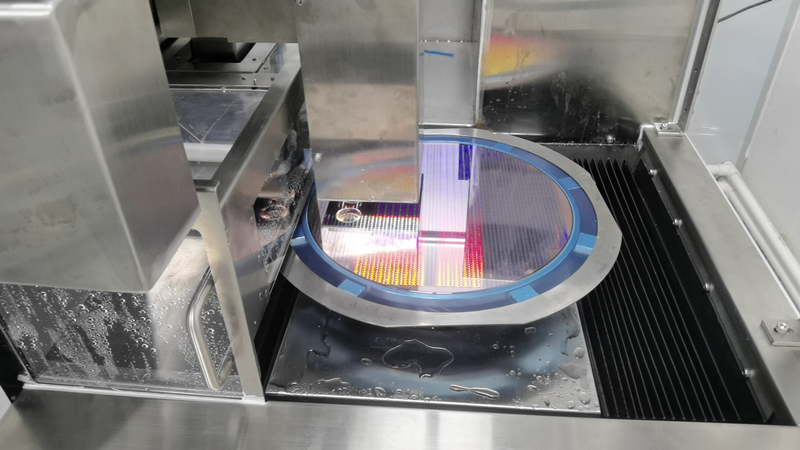
Introducing CO₂ into the dicing water during wafer cutting is an effective process measure to suppress static charge buildup and lower contamination risk, thereby improving dicing yield and long-term chip reliability.
1. Suppressing Static Charge Buildup
During wafer dicing, a high-speed rotating diamond blade works together with high-pressure deionized (DI) water jets to perform cutting, cooling, and cleaning. Intense friction between the blade and the wafer generates a large amount of static charge; at the same time, DI water undergoes slight ionization under high-speed spraying and impact, producing a small number of ions. Since silicon itself tends to accumulate charge, if this charge is not discharged in time, the voltage can rise to 500 V or more and trigger electrostatic discharge (ESD).
ESD may not only break down metal interconnects or damage interlayer dielectrics, but also cause silicon dust to adhere to the wafer surface through electrostatic attraction, leading to particle defects. In more severe cases, it can cause bond pad issues such as poor wire bonding or bond lift-off.
When carbon dioxide (CO₂) dissolves in water, it forms carbonic acid (H₂CO₃), which further dissociates into hydrogen ions (H⁺) and bicarbonate ions (HCO₃⁻). This significantly increases the conductivity of the dicing water and reduces its resistivity. The higher conductivity allows static charge to be quickly conducted away through the water flow to ground, making it difficult for charge to accumulate on the wafer or equipment surfaces.
In addition, CO₂ is a weakly electronegative gas. In a high-energy environment, it can be ionized to form charged species such as CO₂⁺ and O⁻. These ions can neutralize the charge on the wafer surface and on airborne particles, further lowering the risk of electrostatic attraction and ESD events.
2. Reducing Contamination and Protecting the Wafer Surface
Wafer dicing generates a large amount of silicon dust. These fine particles readily become charged and adhere to wafer or equipment surfaces, causing particle contamination. If the cooling water is slightly alkaline, it can also promote metal ions (such as Fe, Ni, and Cr released from stainless steel filters or piping) to form metal hydroxide precipitates. These precipitates may deposit on the wafer surface or within the dicing streets, adversely affecting chip quality.
After introducing CO₂, on the one hand, charge neutralization weakens the electrostatic attraction between dust and the wafer surface; on the other hand, the CO₂ gas flow helps disperse particles away from the dicing zone, reducing their chances of redepositing in critical areas.
The weakly acidic environment formed by dissolved CO₂ also suppresses the conversion of metal ions into hydroxide precipitates, keeping metals in a dissolved state so they are more easily carried away by the water flow, which reduces residues on the wafer and equipment.
At the same time, CO₂ is inert. By forming a certain protective atmosphere in the dicing region, it can reduce direct contact between silicon dust and oxygen, lowering the risk of dust oxidation, agglomeration, and subsequent adhesion to surfaces. This helps maintain a cleaner cutting environment and more stable process conditions.
Introducing CO₂ into the dicing water during wafer cutting not only effectively controls static and ESD risk, but also significantly reduces dust and metal contamination, making it an important means to improve dicing yield and chip reliability.
+86-579-87223657
Wangda Road, Ziyang Street, Wuyi County, Jinhua City, Zhejiang Province, China